ai-powered-markdown-translatorArticle translated from fr to en with gpt-5.6-sol.
This Friday, agent tools are converging around shared formats: Claude Code now reads AGENTS.md when a project has no CLAUDE.md, Antigravity injects the sub-agent catalog into the system prompt of its Markdown agents, Codex breaks down usage by sub-agent, and MiniMax open-sources its terminal agent. The rest of the day comes down to two model releases—Qwen3.8-Omni-Flash and Grok Voice Transcribe 2.0—and an unusual partnership: Anthropic is bringing Accenture evaluators inside its own company.
Claude Code Reads AGENTS.md, Isolates Sub-Agents, and Removes TaskOutput
September 18 — Three versions of Claude Code were released within twenty hours: 2.1.275 on September 17 at 10:33 p.m. UTC, 2.1.276 on September 18 at 2:12 a.m. UTC, and 2.1.277 on September 18 at 6:06 p.m. UTC.
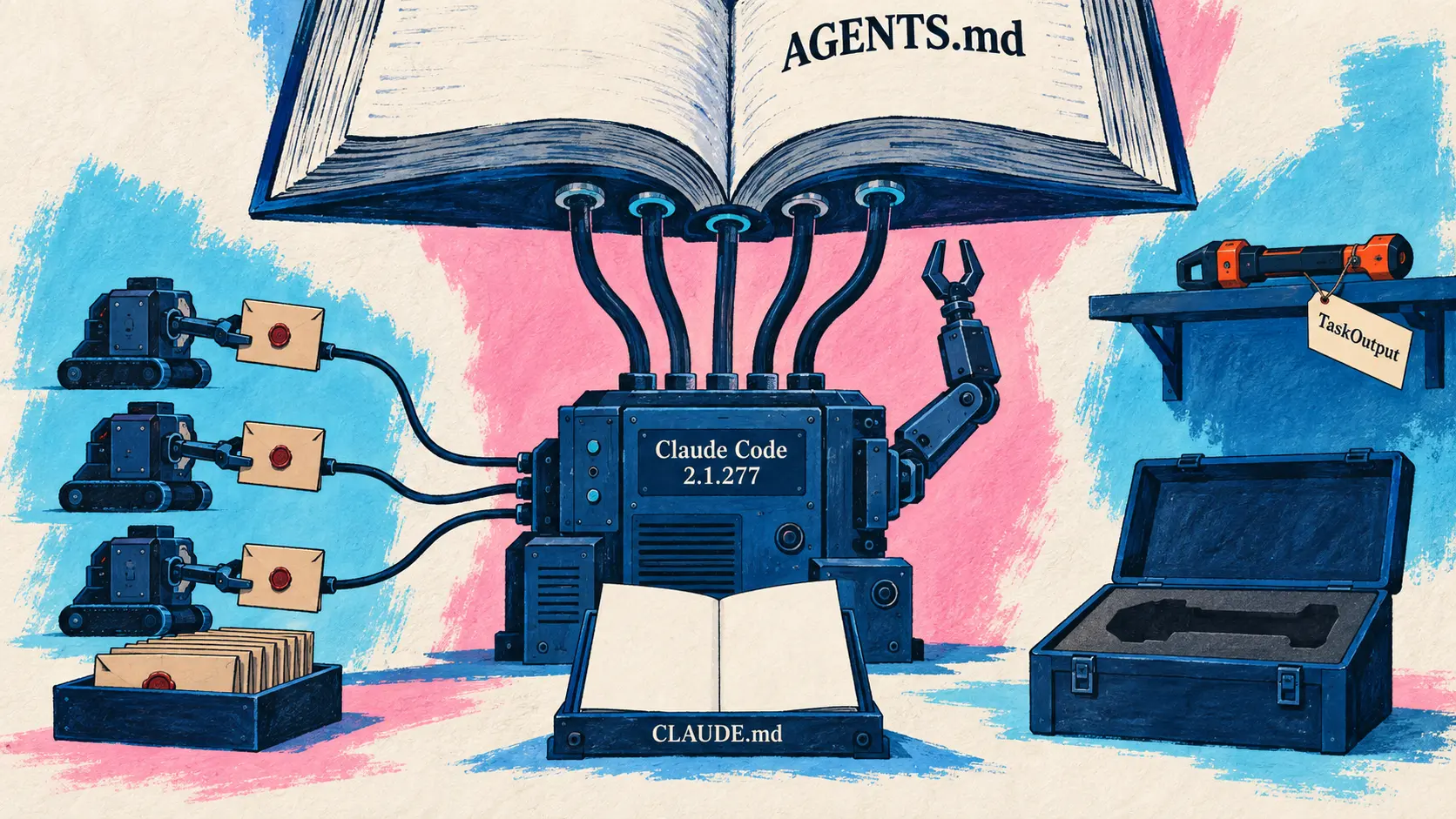
The most significant structural change is contained in a single line of version 2.1.277. In a project without CLAUDE.md, Claude Code reads AGENTS.md, the instruction file that has become a shared convention among several coding agents on the market. The setting can be changed in /config, under “Project instructions.” The feature is not yet available on Bedrock, Vertex, or Foundry.
Added AGENTS.md support: in a project with no CLAUDE.md, Claude Code reads AGENTS.md instead; change it under “Project instructions” in /config (not yet on Bedrock, Vertex or Foundry) — Claude Code CHANGELOG, anthropics/claude-code
Two other changes in the same version address context security. Sub-agent results are returned to the main agent under a header that identifies them as such, preventing text returned by a sub-agent from being mistaken for a session instruction; invisible Unicode formatting characters are also removed from prompts, with the sanitized version displayed before submission. Version 2.1.277 also removes the deprecated TaskOutput tool: Claude now reads a background task’s output file with Read.
Version 2.1.275 adds an immediate-send shortcut (ctrl+enter) that interrupts the current turn and sends all queued messages at once, as well as terminal synchronization for skills and plugins enabled on the claude.ai account. On the supply-chain side, npm-sourced plugins are retrieved using npm pack --ignore-scripts with integrity verification, which prevents a package’s installation scripts from running. Version 2.1.276, released less than four hours later, fixes only one regression from that release: a 400 error that caused all requests behind a proxy to fail.
| Version number | Release (UTC) | Notable changes |
|---|---|---|
| 2.1.275 | 09/17 at 10:33 p.m. | Immediate send, claude.ai skills synchronization, npm --ignore-scripts |
| 2.1.276 | 09/18 at 2:12 a.m. | Single fix: 400 error behind a proxy |
| 2.1.277 | 09/18 at 6:06 p.m. | AGENTS.md support, sub-agent isolation, removal of TaskOutput |
🔗 Version 2.1.277 release notes
Qwen3.8-Omni-Flash, Qwen’s First Agentic Omni-Modal Model
September 18 — Qwen releases Qwen3.8-Omni-Flash, presented as its first omni-modal model designed around agentic capabilities. The stated shift is no longer merely about understanding multimodal content, but putting it to use: understanding the content, planning the task, executing it with tools, and delivering the result. The model accepts text, images, audio, and video within a context window of one million tokens.
Meet Qwen3.8-Omni-Flash, Qwen’s first omni-modal model built around agentic capabilities! — @Alibaba_Qwen on X
Across the 29 evaluations selected by Qwen, the average score improves by more than 25% over Qwen3.5-Omni-Plus, with gains concentrated in audio-video agents. Multi-speaker recognition shows the largest improvement.
| Selected evaluation | Qwen3.8-Omni-Flash | Qwen3.5-Omni-Plus | Gemini 3.8 Flash |
|---|---|---|---|
| WildClawBench-MM | 71.0 | 34.5 | 58.9 |
| UniClawBench | 69.6 | 67.1 | 69.0 |
| AgenticVBench | 36.8 | 14.5 | 45.0 |
| OmniVideoBench | 63.4 | 53.8 | 65.2 |
| StreamingBench | 80.8 | 57.1 | 79.9 |
| AliMeeting DER / cpWER (lower is better) | 3.4 / 17.2 | 88.1 / 89.6 | 72.6 / 53.1 |
The most original aspect is agentic perception applied to long videos. Rather than processing a recording from beginning to end, the model starts from the question asked, decides for itself what to watch and listen to, and locates the information through successive coarse-to-fine passes. On OmniVideoBench, this mode raises accuracy from 63.4 to 67.8 while reducing usage from 145,736 to 79,117 tokens per request, about 45.7% less—a figure stated in the official post itself.
Pricing follows the same direction: according to Qwen’s methodology, the price per hour of audio input falls by more than 98% compared with Qwen3.5-Omni-Plus. Two components are also being opened up: Qwen-MM-Plugins, compatible with the Codex, Claude Code, Qwen Code, and Gemini CLI harnesses, and Qwen-Live Harness for real-time interaction. A Realtime variant is dedicated to continuous, low-latency interaction, with the first token arriving in 591 to 981 milliseconds.
🔗 Qwen post about Qwen3.8-Omni-Flash
Codex CLI 0.155.0 Introduces Voice Conversations as an Experimental Feature
September 17 — OpenAI releases Codex CLI 0.155.0, the first stable version since 0.154.0 on September 10, installable via npm install -g @openai/codex@0.155.0. This is the changelog entry that was missing from the voice agent announced the previous day on X: the feature is named /voice, offers live transcription and microphone controls, and remains experimental—available only on supported builds, and enabled via /experimental.
The rest of the release is less conspicuous but more immediately useful. The terminal interface gains live reasoning summaries in the status line as well as a completion timestamp after each successful turn. The agent overview lets users hide, archive, and delete tasks, with worktree ownership details and confirmation before deleting clean managed worktrees. On compatible Macs, MCP requests from local TUI sessions can be approved with Touch ID. Amazon Bedrock can obtain its AWS credentials from configured commands, with caching, refresh upon expiration, and recovery after authentication failure.
Several fixes concern security: Windows process escapes from restricted WSL sandboxes are blocked, brokered shell snapshots are hardened against credential exposure, and switching accounts invalidates remote-control sessions, cached WebSocket state, and model catalogs belonging to the previous identity.
| New release feature | Details |
|---|---|
/voice | Live transcription and microphone controls, experimental via /experimental |
| Terminal interface | Reasoning summaries in the status line, end-of-turn timestamp |
| Agent overview | Hiding, archiving, and deleting tasks; worktree ownership |
| Touch ID | Approval of MCP requests in local sessions on compatible Macs |
| Amazon Bedrock | AWS credentials obtained by command, with caching and refresh |
🔗 Codex CLI 0.155.0 release notes
Codex Breaks Down Usage by Task, Sub-Agent, and Conversation
September 18 — OpenAI Developers announces detailed usage tracking in Codex: the tool shows how tasks, sub-agents, and individual conversations contribute to total usage. The information is available in the desktop app under Settings, then Usage & billing for personal and Business accounts, or under Usage for eligible Enterprise accounts; the app must be up to date to access it. No blog post or changelog entry accompanies the announcement.
Granularity is the real point. Until now, an exhausted quota did not reveal where the usage came from; a breakdown by sub-agent makes it possible to identify which delegation is costly and rewrite it. It is the accounting counterpart to the spread of sub-agents across coding harnesses.
🔗 OpenAI Developers announcement on X
Grok Voice Transcribe 2.0, SpaceXAI’s Speech Recognition at the Same Price
September 18 — SpaceXAI announces Grok Voice Transcribe 2.0, its new speech-to-text model, described as twice as accurate as version 1.0 at the same price. The model is built on the audio foundation that already powers Grok Voice, which, according to the company, handles tens of thousands of customer-support calls per day and transcribes millions of hours of video narration.
The central argument focuses on real-world audio rather than laboratory audio: unstable phone lines, competing voices, local accents, and phone numbers and email addresses dictated aloud. SpaceXAI claims the top spot for accuracy among 32 streaming models on the public Artificial Analysis leaderboard and relies on four internal datasets drawn from production traffic—8 kHz telephony, conversations with Grok, dictated identifiers, and short voice commands in 19 languages.
The clearest gain is in multilingual performance. On the short-phrase dataset, whose samples provide the least context for identifying the language, the word error rate falls from 20.6% to 6.8%. The model detects the language automatically and tracks changes during a recording in a single pass.
| Measured metric | Announced value |
|---|---|
| Claimed accuracy compared with Transcribe 1.0 | twice as high |
| Artificial Analysis ranking (streaming) | 1st out of 32 models |
| Error rate on short phrases (1.0 → 2.0) | 20.6% → 6.8% |
| Batch price | $0.10 per hour of audio |
| Streaming price | $0.20 per hour of audio |
| Channels transcribed independently | up to 8 |
| Domain-specific terms per request | up to 100 |
The model supports batch and streaming processing, word-level timestamps with confidence scores, speaker separation (diarization) at no additional cost, and end-of-turn detection. Existing API integrations receive the accuracy improvement without code changes. Grok Voice Transcribe 2.0 will soon become the API’s default model, and version 1.0 will be deprecated in the coming weeks: users will need to pin grok-voice-transcribe-1.0 to remain on it.
🔗 Grok Voice Transcribe 2.0 announcement
Anthropic Brings Accenture Evaluators Inside the Company
September 18 — Anthropic announces a partnership with Accenture for the independent evaluation of frontier models, presented as a major step toward its CEO’s commitment to host embedded evaluators. The work will be conducted by Faculty, Accenture’s AI-focused subsidiary, and will cover model evaluation and red-teaming, alignment evaluations, and guardrail testing.
The distinction from external evaluators is explicit: an embedded evaluator works inside the AI company with access comparable to that of an employee. They can observe models during training, follow the decisions governing their construction and deployment, speak directly with employees, verify that safety commitments are being upheld, report incidents, and publish a better-informed account of the benefits and risks. Anthropic emphasizes that the arrangement does not reduce its accountability but makes it more verifiable.
The announcement is unusually candid about what does not yet exist. There is no standard governing what information an embedded evaluator should be able to access, how findings should be published, or how independent evaluation should be funded. Anthropic believes that, in time, this funding should come from pooled or public funds; in the absence of such a mechanism today, it is directly financing Accenture’s work—which is the arrangement’s most visible limitation.
| Partnership element | Announced value |
|---|---|
| Operating entity | Faculty, Accenture’s AI subsidiary |
| Investment | At least $1 billion per party over five years |
| Scope | Evaluation, red-teaming, alignment, guardrails |
| Access level | Comparable to that of an employee |
| Funding | Directly from Anthropic, in the absence of pooled funding |
| Exclusivity | None, on either side |
Anthropic also says it is discussing with METR and other nonprofit evaluators ways to experiment with elements of embedded evaluation using their own funding, and announces that more partners will be named in the coming weeks.
🔗 Anthropic announcement on embedded evaluation
Antigravity: three releases in two days focused on custom agents
Google released two versions of its CLI and one version of the Antigravity application in quick succession. All three address the same topic from three angles: what a custom agent knows, what it can refuse, and how long it can run unattended. They extend a dense series that began on September 11, whose versions 1.2.1 through 1.2.4 are not covered here.
CLI 1.2.6 introduces session-scoped Remote Control and removes the five-minute limit
September 18 — Eight days after 1.2.0, which turned the CLI into a persistent system service, Google takes the opposite approach with a second, much lighter form of Remote Control: a session-scoped connection, opened with the --remote-control flag at startup or the /remote-control command while running. Entering /remote-control off or closing the session tears down the tunnel and removes the device from the list. While 1.2.0 targeted a daemon that survives the session, 1.2.6 targets the opposite.
The second change concerns headless mode: the default timeout for -p / --prompt runs changes from five minutes to unlimited, unless --print-timeout is explicitly set. The third change structures error reporting—when an agent or API fails, the CLI writes a AGY_ERROR: {...} JSON line to standard error containing the canonical status, the HTTP or gRPC code, whether the error is retryable, and an error identifier, with the exit code changing from 1 to 3. An orchestration script can therefore distinguish a temporary network failure from a permanent error without parsing free-form text.
CLI 1.2.5 finally gives Markdown agents a directory of their sub-agents
September 17 — Until now, a custom agent defined in Markdown could declare invoke_subagent among its tools without ever knowing which sub-agents existed: it had the tool but not the directory. The CLI now automatically adds the catalog of available sub-agents and instructions for using them to its system prompt, making delegation effective.
The changelog’s wording calls for caution: this is context added by the product itself, not a security vulnerability or a fix. The second improvement preserves the explicit name of a task sent to the background, which used to be lost between notifications and task lists. The five fixes address purging invalidated identifiers, exit codes for interrupted commands, and reasoning frames that remained frozen.
Antigravity 2.15.0 lets custom agents disable default prompts and tools
September 18 — Three days after 2.14.0, the application releases 7 improvements and 16 fixes. The main change gives custom agents control over their own context: they can disable default prompt sections and default tools, then reintroduce only those they need. For a specialized agent, this reduces the imposed system prompt accordingly.
The rest concerns navigation and persistence: Page Up, Page Down, Home, and End scroll through a conversation, Escape exits the input area, and the selected custom agent is remembered after a reload. Two fixes address data integrity—saved settings and the project list could be overwritten when the application failed to read its state file, and permission settings accumulated duplicates that caused conversation files to grow.
GitHub Copilot: a Sentry canvas, six retired models, and per-customization metrics
Three changelog entries in two days reflect the same concern: measuring what teams actually do with Copilot and cleaning up what they no longer use.
The September 14 recap highlights two new building blocks
September 18 — GitHub publishes its weekly Copilot recap for the week of September 14. Most of the summary repeats entries already published throughout the changelog; only two items had never been announced separately. The first is the Sentry canvas in the Copilot application, which connects a production crash report to a fix without leaving the application: it displays errors, stack traces, and context, then makes it possible to investigate the cause, validate a fix, and prepare a pull request. It is the first integration of an error-monitoring tool into canvases, following Jira in early September.
The second is the VS Code 1.138 agents wave. The Agents window can run an agent in a local Dev Container, with the project’s tools and dependencies—gradual rollout, Docker required. Inactive sessions can automatically be marked as completed once all their pull requests have been merged, with optional deletion after a grace period, in preview and requiring explicit activation. Finally, a pull request can be created directly from an Agent Host session.
Six models leave all Copilot surfaces on October 19
September 18 — GitHub announces the retirement of six models from all Copilot surfaces—Copilot Chat, inline edits, ask and agent modes, and code completions—on October 19, 2026. This is the second deprecation wave announced in September.
| Retired model | Retirement date | Suggested alternative |
|---|---|---|
| Gemini 3.7 Flash | 19/10/2026 | Gemini 3.8 Flash |
| GPT-5.5 | 19/10/2026 | GPT-5.6 Sol |
| GPT-5.4 | 19/10/2026 | GPT-5.6 Sol |
| GPT-5.4 mini | 19/10/2026 | GPT-5.6 Luna |
| GPT-5 mini | 19/10/2026 | GPT-5.6 Luna |
| Grok 4.5 | 19/10/2026 | Grok 4.6 |
Under default model enablement, the alternatives are automatically enabled for Copilot Enterprise and Business customers, unless an administrator has disabled the global default or explicitly blocked the model in question; in that case, access can be restored through model policies in the settings. No action is required to remove the models.
🔗 Copilot model deprecation announcement
The metrics API counts CLI skills, agents, MCP servers, and plugins
September 17 — The Copilot usage metrics API now covers five families of agentic CLI customizations: skills, custom agents, MCP servers, slash commands, and plugins. The totals_by_skill, totals_by_custom_agent, totals_by_mcp, totals_by_slash_cmd, and totals_by_plugin arrays list the five most active items with their interaction_count, while the distinct_*_use_count fields count the variety of items used beyond this top five.
Two nuances prevent misunderstandings. For MCP servers, the counter increases only when the CLI attempts to connect or reconnect—whether successful or unsuccessful—not on every tool call over an established connection. Plugin metrics count only skill invocations associated with a plugin: they are a subset of skill totals and must not be added to them. For privacy, only names provided by GitHub are displayed, while names defined by customers are grouped under other.
🔗 CLI agentic customizations in the metrics API
Terminal coding agents: MiniMax open-sources its own, Mistral stabilizes its harness
Two announcements from two unrelated companies, on the same day, in the same market: terminal-based coding agents are becoming commonplace, and differentiation is shifting toward licensing and harness stability.
MiniMax releases MiniMax Code CLI under the MIT license
September 18 — MiniMax open-sources version 0.4.12 of its terminal coding agent. The tool is installed under the name mcode and offers three entry points: an interactive terminal interface, a headless mode (mcode exec) intended for shell scripts, continuous integration, and evaluations, and an ACP mode for editors compatible with the Agent Client Protocol. It reads project files, inspects diffs, and runs shell commands and tests under a permissions and sandboxing framework.
The model choice remains open: a MiniMax account and its Token Plan on one side, or a third-party provider on the other, provided it exposes an OpenAI- or Anthropic-compatible API format. It also includes built-in search, multimodal tools, the MCP protocol, sub-agents, and a plugin system. The first-party code is published under the MIT license by default. The repository covers the TUI, the headless CLI, and ACP mode, but not the desktop application, although it does host its issue tracker; code contributions are currently accepted only from repository collaborators.
Vibe CLI’s Unified Harness leaves experimental status
September 18 — Mistral releases Vibe CLI 2.25.5, six days after 2.25.4. The structural change is captured in one line of the release notes: the Unified Harness is no longer labeled “experimental,” and --legacy-harness is now the documented escape hatch to the old Python harness. After a series of corrective releases focused on shell approval security, the new harness becomes the acknowledged default—that is the news, not the version number.
The transition comes with a push to achieve feature parity: the Unified Harness now injects the current Git branch, repository status, and recent commits into the system instructions; hooks finally run inside sub-agents instead of being silently ignored; and providers configured without an API-key environment variable—local or self-hosted servers—work again. Permission hardening continues: shell approvals no longer expand to another program or environment, MCP tool calls now respect the permission system instead of bypassing it, and smart approve no longer circumvents the user’s rules.
🔗 Vibe CLI 2.25.5 release notes
ChatGPT plugins support multiple accounts at once
September 18 — Support for multiple accounts is coming to most ChatGPT plugins. Users can link their personal account, work account, and side-project accounts, then bring context from each into the same conversation. Accounts are connected from the plugin directory at chatgpt.com/plugins.
The announcement from the OpenAI Developers account repeats a post by Max Stoiber published an hour earlier. Plugin developers do not need to do anything: the feature is activated automatically, with no changes required. Those who want to go further can add a profile tool to their MCP server so that ChatGPT can label connected accounts—this is the only concrete action expected of them. No blog post or changelog entry accompanies the announcement, published at 6:10 p.m. Paris time.
The intended use case is a developer who separates identities by employer or project and previously had to switch logins to change context.
🔗 Multiple-account announcement on X
Genspark adds a weekly credit balance to Plus and Pro plans
September 18 — Genspark changes the benefits of its Plus and Pro subscriptions by adding a weekly credit balance without changing plan prices. This balance arrives each week in addition to the existing plan allowance and covers Standard mode usage across all the platform’s agents and tools: Super Agent, AI Chat, AI Image, AI Slides, AI Sheets, AI Docs, and Deep Research.
A second post in the same thread explains how this works for AI Chat and AI Image. For existing subscribers, the balance is added to what they already have and, through December 31, 2026, all AI Chat and AI Image models can be used at no credit cost, including flagship models such as Opus; for people who subscribe on or after September 18, AI Chat and AI Image core models are free. Genspark specifies that these changes apply neither to Team plans nor to Enterprise plans, and refers users to its help center for detailed terms.
Google Research: what AlphaGenome Atlas has produced, and simulations that test themselves
Two research publications on the same day, with one thing in common: in both cases, what is shown is not the model itself, but what third parties have derived from it, or what the validation loop verifies on its behalf.
AlphaGenome Atlas delivers the first results from its partners
September 17 — Nine days after the release of AlphaGenome Atlas, the predictive map of the 9 billion possible substitutions in human DNA, Google DeepMind pins a thread detailing three collaborations.
| Scientific partner | Reported result |
|---|---|
| Stowers Institute | More than 2,500 regulatory motifs mapped |
| University of Exeter / UK Biobank | More than 54,000 participants analyzed, over 22% greater detection of rare genetic signals |
| Broad Institute | Critical DNM1 gene mutation identified, then confirmed and validated in the laboratory |
Regulatory motifs are DNA sequences that act like switches and dimmers for gene activity. The work conducted at Exeter also identified new variants influencing the abundance of PLA2G7, a protein linked to metabolic health. The Broad Institute case is the most concrete of the three: faced with an immense list of possible mutations in unexplained rare diseases, Atlas is used to pinpoint the right one, which is then confirmed at the lab bench. The whole account, however, is confined to a thread on X, with no detailed post or associated publication.
🔗 AlphaGenome Atlas thread on X
Generated Educational Simulations, Then Tested by an Agent in Chrome
September 17 — Gal Elidan and Yael Haramaty published an experiment applying generative UI to the creation of educational simulations. The teacher remains in control: they propose the topic, Google generates a set of editable learning objectives for their approval, and these serve as the basis for generation. Each interactive experience is divided into increasingly difficult levels, with a toolbox, progressive hints, and detailed solutions.
The most interesting element is the self-correction loop. Generation is checked against pedagogical, mechanics, and presentation criteria, and some evaluations are agentic: the solvability test opens a Chrome instance and manipulates the simulation as a user would, while also attempting adversarial actions such as pushing sliders to their extreme values. The loop repeats until all criteria are met, at the cost of a longer generation time. Google has released more than 30 STEM interactives in English; a collection of 40 was evaluated by British teachers, and a study involving 12 American teachers produced an average score of 8 out of 10.
🔗 Google Research post on educational interactives
Claude Accelerates More Than 30 Biology Models and Funds a Protein Competition
September 17 — Anthropic published a post describing how Claude optimized inference for more than 30 open-source models used by biologists—including structure prediction, protein design, protein language models, and genomics—in just under four weeks, achieving an average speedup of about 4x. All the code has been released as open source.
The technical core focuses on triangular attention and triangular multiplication, both cubic in time and memory. Claude produced FlashPairformer, a set of kernels that outperforms the industry standard by 2.7 to 2.9x on attention. A low-memory mode called “Big” can accurately fold systems containing more than 10,000 tokens on a single GPU node, whereas the 40S ribosome predicted by AlphaFold3 contained 7,663 tokens. The methodology matters just as much: the work was supervised by two technical staff members with no prior experience in inference optimization.
Finally, Anthropic is co-sponsoring a protein design competition with Adaptyv Bio covering five difficult problems, with more than 5,000 community designs to be experimentally validated, up to 250,000 in compute provided by Modal.
Open Models and Labs: Muse Comes to Mac, Sakana Unveils Its Frontier Group
Meta Brings Its Muse Agent to macOS
September 18 — Meta is rolling out Muse on Mac, announced overnight from September 17 to 18. The @AIatMeta account shared a post describing a personal agent capable of acting directly on the user’s computer, with their explicit permission each time. Three use cases are mentioned: organizing the downloads folder, finding a lost file, and summarizing messages and notes.
The announcement follows Muse’s September 8 launch. Powered by Muse Spark 1.3, the agent had previously been available on iOS, Android, the web, and WhatsApp. Moving to Mac marks a new stage for this type of product: the agent no longer works in its own sandbox but on the user’s personal files. Meta has disclosed neither pricing, availability by country, nor system requirements, and no Mac-specific security document accompanied the release—the ai.meta.com blog has published nothing since July 27.
Sakana AI Unveils the Frontier Intelligence Group and Its Position on the Paradigm
September 18 — Sakana AI announced the existence of the Frontier Intelligence Group (FIG), an internal collective that has been growing since the company’s early days. Its starting point is a question posed by Llion Jones, Sakana AI’s chief technology officer and one of the inventors of the Transformer: is scaling the Transformer architecture with ever more data and compute enough to reach AGI? The lab’s answer is no.
That is where the real news lies, more than in the accompanying catalog of research. The post lists the shortcomings that the current paradigm has not resolved—models that confidently produce false information, collapse when faced with genuinely novel situations, and consume large amounts of energy—and contrasts them with biological intelligence, which learns continuously and generalizes from far less data. The group has adopted five principles, including the freedom to fail without pressure over benchmark scores. Among the work presented, hollow Transformers developed with NVIDIA begin from a measured observation—more than 95% of the neurons in a feed-forward layer remain silent while processing a word—and have produced a data format called TwELL, accepted at ICML 2026.
🔗 Sakana AI post on the Frontier Intelligence Group
Generative Video: Runway Unifies Its Credits, Pika Releases Its First Application
Runway Makes Credits Fungible Across the Web App and Runway Dev
September 18 — Runway is removing the barrier between its two products: purchased credits can now be used interchangeably in the web app and Runway Dev, its developer offering. Until now, the two environments had separate credit pools, distinct contracts, and no single place to track consumption across projects.
Four elements accompany the change: a single centrally purchased pool on one invoice, a continuous path between building a workflow in the web app and exposing it through an API, enhanced support for Runway Dev with access to Applied AI Architects, and a redesigned workspace analytics view that allows administrators to transfer credits between web and Dev workspaces. Two commercial offers are valid through December 31, 2026: 10% additional credits upon signing for new enterprise customers, equivalent to at least 130 minutes of video or 12,000 images based on Runway’s stated conversion rate; and, for existing customers, 5,000 credits plus one day with an Applied AI Architect in exchange for a referral to the AI applications product lead.
🔗 Runway post on unified pricing
Pika Launches Product Ad, Turning Product Photos into Video Ads
September 18 — The day after unveiling its new creative platform, Pika released its first application: Product Ad. The application takes one or more product images, combines them with a written brief, and turns them into a video presented as market-ready.
| Generation parameter | Offered value |
|---|---|
| Available durations | 6 s, 15 s, 30 s, 60 s, 2 min |
| Output format | 16:9 |
| Expected input | product images and written brief |
| Access | account creation required |
Pika published the announcement while quoting its own message from the previous day about the platform redesign, positioning Product Ad as part of an expected series of applications rather than as an isolated feature. No model is named, and no pricing has been disclosed.
NVIDIA Releases AIPerf, the Successor to GenAI-Perf for Measuring Inference at Scale
September 18 — NVIDIA introduced AIPerf, its performance measurement tool for generative inference, described as the successor to GenAI-Perf and rewritten from scratch. The starting observation is familiar: once a model is deployed, the question “is it fast?” is often answered with curl commands or an improvised load generator, producing figures that cannot be trusted.
The key change is architectural. While most tools run in a single process and encounter Python’s global interpreter lock as concurrency rises, AIPerf distributes the work: worker processes generate the load, separate services process the results, and everything is coordinated through ZMQ. The goal is explicit—to ensure that the measurement client never becomes the bottleneck itself.
| Reported metric | What it measures |
|---|---|
| Time to First Token | Delay between sending the request and the first token |
| Inter-Token Latency | Delay between two successive tokens during generation |
| Request latency | End-to-end time for the complete response |
| Output token throughput | Tokens produced per second across all requests |
| Reported percentiles | p25, p50, p75, p90, p95, p99 |
| Endpoint types | more than 15 |
The tool can also replay real-world traffic traces in Mooncake, Baseten, and WEKA formats. The article particularly emphasizes the usefulness of distributions: a server whose average time to first token appears healthy but whose p99 soars may go unnoticed in aggregate metrics and fail in production.
Mistral Denies a Claim of Unauthorized Access to Its Systems
September 18 — At 05:48 UTC, Mistral published a brief statement on its X account in response to a claim of unauthorized access to its systems. The company says it conducted a thorough investigation, found no evidence supporting the claim, and confirms that its systems were not compromised.
We are aware of a claim alleging unauthorized access to our systems. Following a thorough investigation, we have found no evidence to support this claim and can confirm that our systems have not been compromised. — @MistralAI on X
The message does not identify who made the claim, specify its date or nature, or provide any details about the scope of the investigation. Only Mistral’s position is reported here: the original allegation could not be reviewed. The statement was the account’s most-viewed post during the period, and no follow-up publication was found on the company’s website.
Briefs
- Balyasny Asset Management explains how it governs Claude Fable 5 — the firm, which manages approximately $38 billion, has reduced the initial analysis of a merger arbitrage from three to five days to less than one day, using an agent that runs for about 30 minutes followed by human review. 🔗 source
- Codex CLI 0.155.1 disables reasoning summaries by default again — a single fix released the day after 0.155.0: enabling them by default caused requests to be rejected by providers that do not support them. 🔗 source
- Gemini CLI resumes its nightly series after a blank day — four changes on September 18, including retaining the OAuth refresh token during renewal and making credential deletion idempotent; the stable and preview channels remain unchanged. 🔗 source
- Kimi Code 2.0.1 speeds up startup and session resumption — a patch release 32 hours after 2.0.0: session index compaction, faster resumption for long histories, an API key readable from a named environment variable, and bounded file watchers. 🔗 source
- Qwen Code moves to v0.24.1 preview with a Playwright browser SDK — this is not a stable release; it introduces built-in browser control with a Chrome native messaging relay, as well as containerized sub-agent execution. 🔗 source
- Zed releases stable version 1.20.2, with only two fixes — payment errors from third-party model providers no longer display an invitation to upgrade to Zed Pro instead of the original message, and two snippet extensions for the same language no longer cancel each other out. 🔗 source
- Replit claims a “30 times more” generous Free Mode, without a published reference — a standalone tweet, with no link or changelog, that does not specify what this factor is being compared with: it should be treated as a claim by Replit, not as a measurement. 🔗 source
- The Copilot impact dashboard breaks down engagement by feature — seven surfaces over 28 days, distinguishing between active and passive code review, with the adoption-phase population now calculated using a rolling window. 🔗 source
- GitHub schedules a live introduction to the Copilot SDK in six languages — sessions, tools, MCP servers, and streaming events, with dedicated .NET and Java sessions and no prerequisites. 🔗 source
- Runway Ruby preserves the alpha channel during HDR conversion — converting footage to HDR keeps transparency intact in a single step; neither pricing nor subscription tier is specified. 🔗 source
- MiniMax joins the Singtel AI Pass for Singapore’s SkillsFuture program — MiniMax H3, MiniMax Agent, and MiniMax Audio are joining the offering, which is aimed at eligible learners across more than 200 SWDA-supported AI courses; no amount or timeline is given. 🔗 source
- VC-Attention accelerates MiniMax-H3 attention without retraining — MiniMax is highlighting Nunchux AI’s work on low-precision attention that can be applied to the existing model; Nunchux AI reports 1.6x on B200 and 1.5x on B300 compared with FlashAttention-4. 🔗 source
- Wan3.0 ranks second in the OpenArt Arena video category — Alibaba highlights 30-second shots, native audio, and support for any reference; this is a position in a third-party ranking, with no new product announcement. 🔗 source
- Synthesia opens its US headquarters in New York — corporate news with no product, staffing, or investment timeline, two days after the general availability of its Interactive Avatar API. 🔗 source
- Grok Imagine details the cost of a pilot produced entirely with AI — PJaccetturo’s studio reports nine days of work, 3,627 generated images, and 3,043 generated videos, costing $2,677 in generation fees for the pilot episode of its Odyssey competition. 🔗 source
- BananaMind 2 Pro approaches SmolLM2 with twenty times fewer tokens — a 139-million-parameter model trained on 100 billion tokens and an RTX 5070 Ti scores 42.78% on HellaSwag, compared with 43.22 for SmolLM2-135M, which was trained on 2 trillion tokens. 🔗 source
- Optimum-Intel v2.2.0 and OpenVINO GenAI 2026.4.0 expand exports to Intel hardware — Hugging Face and Intel have released joint versions covering Intel CPUs, GPUs, and NPUs, with Mistral 3 now exportable. 🔗 source
- AmberTrace Labs measures the reasoning faithfulness of Olmo 3 under RL with verifiable rewards — on probes withheld from training, faithfulness rises from 0.238 to 0.262: a positive shift rather than erosion, with checkpoints published. 🔗 source
- Together AI claims the best time to first token on DeepSeek V4.1 Flash — the company is relaying a third-party measurement for prewarmed requests without publishing either the methodology or the value: a claim, not a verifiable result. 🔗 source
- Google Flow supports two creators at New York Fashion Week — custom tools designed with Jane Wade and Sergio Hudson; a use-case showcase, with no new model or deployed feature. 🔗 source
- The Google AI Educator Series now qualifies for university credits — the training courses are now eligible for university or continuing education credits. 🔗 source
What It Means
Above all, the day points to one thing: coding agents are ceasing to be closed products and beginning to share their formats. Claude Code reads AGENTS.md when a project does not have a CLAUDE.md — meaning Anthropic is accepting an instruction file defined elsewhere so that the same repository can serve multiple tools. On the same day, Antigravity is injecting the catalog of available sub-agents into the system prompt of its Markdown agents, Vibe CLI is finally making hooks run inside sub-agents, Codex is itemizing its billing by sub-agent, and Qwen Code is putting its own in containers. Delegation between agents used to be a configuration promise; it is becoming a mechanism that must be documented, isolated, and billed. Claude Code even follows the logic of distrust to its conclusion by marking sub-agent results with a dedicated header, so that returned text cannot masquerade as an instruction.
The terminal-agent market, meanwhile, is rapidly becoming commoditized. MiniMax is releasing its own under the MIT license with a TUI, headless mode, ACP, and unrestricted model choice; Mistral is removing the “experimental” label from its Unified Harness and documenting --legacy-harness as an escape hatch; Kimi Code is shipping a performance fix 32 hours after its major release. When four vendors offer the same object with the same entry points, differentiation shifts elsewhere: to the license, harness stability, and permission model — precisely the areas targeted by the day’s changes at both Mistral and Anthropic.
For models, the trend is toward audio and video becoming agentic rather than descriptive. Qwen3.8-Omni-Flash no longer tries to describe a video but to find an answer within it: starting from the question, it gains 4.4 points on OmniVideoBench while consuming 45.7% fewer tokens — performance and efficiency moving in the same direction, which is rare. Grok Voice Transcribe 2.0, by contrast, is not staging a laboratory demonstration but handling real-world traffic, with its error rate on short utterances falling from 20.6% to 6.8% at an unchanged price. The two announcements converge: value no longer comes from the modality being supported, but from what the model decides to process.
What remains is the question of what laboratories are willing to have independently verified. Anthropic is paying Accenture to place evaluators inside its own company, with employee-level access — while acknowledging in the same announcement that no standard exists for what such an evaluator should be allowed to access, how its findings should be published, or who should fund it. It is as much an admission as it is a framework. By comparison, the day’s strongest evidence is what a third party can reproduce: the results from Exeter and the Stowers Institute on AlphaGenome Atlas, the open-source biomolecular optimization code, and the AmberTrace Labs checkpoints. The opposite is equally visible: Replit cites a factor of 30 without a reference, Together AI relays a ranking without a methodology, and Mistral denies an allegation that no one was able to read. In this landscape, AIPerf arrives at exactly the right time — a measurement tool that begins by admitting that the measurer is often the problem.
Sources
- Claude Code, version 2.1.277 release notes
- Claude Code CHANGELOG
- Qwen, Qwen3.8-Omni-Flash post
- Alibaba Qwen on X, model announcement
- Codex CLI, version 0.155.0 release notes
- OpenAI Developers on X, detailed usage in Codex
- SpaceXAI, Grok Voice Transcribe 2.0
- Anthropic, embedded evaluation with Accenture
- Antigravity changelog
- GitHub, September 14 Copilot weekly recap
- GitHub, deprecation of six Copilot models
- GitHub, agentic CLI customizations in the metrics API
- MiniMax on X, open-sourcing MiniMax Code CLI
- Vibe CLI, version 2.25.5 release notes
- OpenAI Developers on X, multi-account plugins
- Max Stoiber on X, the original post about multiple accounts
- Genspark on X, the weekly Plus and Pro balance
- Google DeepMind on X, AlphaGenome Atlas partner results
- Google Research, educational interactives through a generative interface
- Anthropic Research, Claude and biomolecular modeling
- Meta AI on X, Muse for Mac
- Sakana AI, the Frontier Intelligence Group
- Runway, unified pricing
- Pika on X, Product Ad launch
- NVIDIA, measuring large-scale inference with AIPerf
- Mistral AI on X, September 18 denial