ai-powered-markdown-translatorArticle translated from fr to en with gpt-5.6-sol.
On Saturday and Sunday, the labs went quiet: neither DeepSeek, Meta, Ai2, Sakana, Mistral, nor xAI published anything, and the official accounts in the open-model field remained empty for two days. There was only one genuine release: Qwen-Image-2.1, published with open weights on Sunday in the middle of the afternoon. Most of the rest amounts to five posts on the Hugging Face community blog, an Antigravity release that fixes nothing, and two GitHub changelog entries caught up from September 18—a quiet day that there is no reason to inflate.
Qwen-Image-2.1, a single model for generation, editing, and transparency
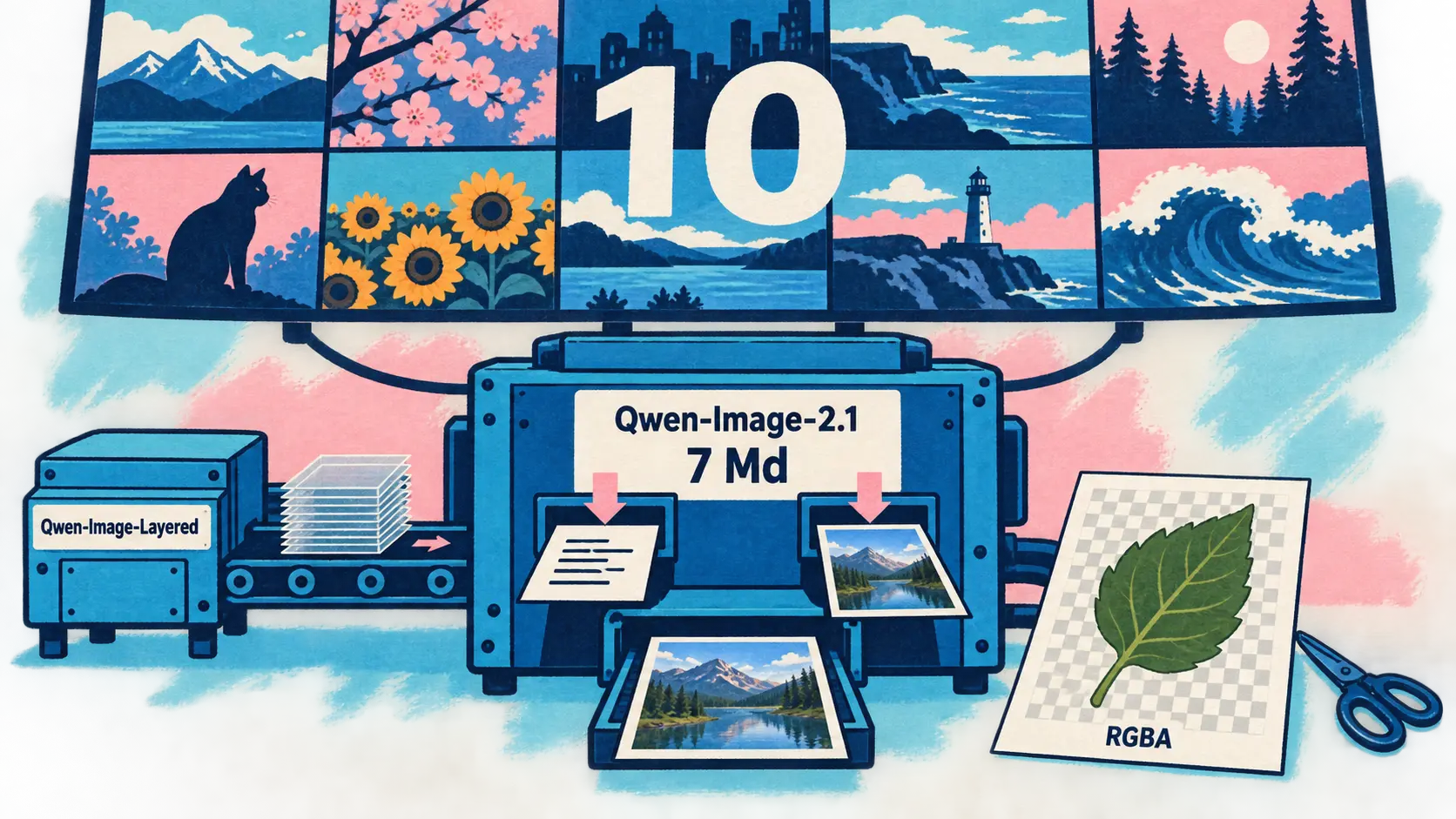
September 20 — Qwen released Qwen-Image-2.1, its image generation and editing model, with open weights on Hugging Face, ModelScope, and GitHub. The selling point is not size but unification: the same set of weights covers both creation from a text prompt and retouching existing images, whereas those two uses previously required two models.
The most tangible new feature is native transparency: the model directly produces and modifies RGBA layers, with the prompt determining whether the output includes a transparency channel. Qwen had offered this capability since December 2025 through a dedicated model, Qwen-Image-Layered, which has now been absorbed. One cutout step disappears: extracting a subject from a photograph as a reusable layer, or replacing text in a transparent layer.
For editing, the model accepts up to 10 reference images for a single composition, and the area to retouch can be designated with a colored circle, a painted annotation, or a separately supplied mask—the third option exists because the first two cover the original content. Its efficiency relies on mixed-granularity attention, with editing inputs forming a static context cached from the first step.
| Technical element | Announced value |
|---|---|
| Visual generation parameters | 7 billion, across 32 Single-Stream DiT layers |
| Reference images accepted | Up to 10 |
| Output transparency | Native RGBA layers, for both generation and editing |
| Dedicated model absorbed | Qwen-Image-Layered, released in December 2025 |
| Day-one support | vLLM-Omni and ComfyUI |
Qwen published a comparison on Qwen-Image-Bench, but its values appear only in an image in the post, so they are not reproduced here.
Generate, edit, and create transparent images with one model: a 7.1B DiT paired with Qwen3-VL-8B. — @vllm_project on X
Qwen Code v0.24.2, full voice support in Web Shell and an expanded bwrap sandbox
Same publisher, same day, unrelated product. September 20 — released just over twenty-four hours after v0.24.1, v0.24.2 of Qwen’s command-line coding agent is the first release in its series with no breaking changes, whereas each of the previous two had one.
The bubblewrap sandbox gains a complete execution foundation: structured process launching, supervision, and confined workers. In the same vein, a workspace with undecided trust status now requires an explicit decision. Web Shell, meanwhile, makes Live Voice genuinely usable: the model and voice can be selected from the configuration card, and the microphone level is displayed during the call. For anyone running several sessions in parallel, each incoming message is now evaluated for its intended session, and the prompt cache is preserved for deferred tools.
Verifying an answer without writing a token, and a ranking whose author is both judge and interested party
September 20 — Two posts, on the same day, about the same set of 2,018 items. The first presents Zero-Token Confidence: a probe reads the model’s final hidden state in a single forward pass and derives a calibrated probability from it, without generating a token. Asking whether it is confident yields an area under the curve of 0.5000, equivalent to chance; reading its internal state yields 0.8801, in 0.0615 seconds versus 1.631 to generate an answer. The second tests thirteen verifiers: only three exceed 0.70, and ZTC leads JEV by 0.0014, an indistinguishable gap.
The strongest finding lies elsewhere: a baseline that looks only at the answer’s length and formatting, never its content, reaches 0.7036 and beats eight of the thirteen systems. One caveat: the ranking’s author is not a neutral third party—he says he is also measuring his own system, without identifying which of the thirteen it is, and both posts appeared on the same day. The figures may be accurate; the ranking’s independence has not been established.
A $54 LoRA that fixes and breaks things at the same time
September 20 — For $53.88, ScalablyAI trained two LoRA adapters on Qwen3.8-27B using the 143,145 tool-use traces left by its agent platform, then evaluated them against a suite frozen before the first training step.
The result cuts both ways. Across 73 recovery states following a rejected tool call, the adapter rises from 31 to 38 successes, with seven cases shifting in its favor and none against it. But across 73 clean trajectory decisions, it falls from 49 to 45, a drop of five and a half points against a threshold set at two. Because unloading an adapter is atomic, avoiding the regression required abandoning the gain: both were rejected. Hence the architecture ultimately chosen—433 editable memory rules on one side, with the weights left untouched on the other.
If every useful experience immediately changes the weights, learning and corruption can become the same operation, and at production sample sizes you cannot tell which one you performed. — pavle-scalably on the Hugging Face blog
🔗 Full report and evidence ledger
SeamFlow places UV seams where an artist would
September 20 — Unwrapping a 3D surface into 2D requires cutting it; good unwrapping places those seams where they will be least visible. SeamFlow, presented by Meshy AI with the City University of Hong Kong, Bambu Lab, and Nanyang Technological University, changes the representation before the model: each mesh edge becomes a token, and the binary label is relaxed into a continuous value, making flow matching applicable.
The benefits are structural: there is no projection step or arbitrary token order, and every predicted cut falls on an existing edge. Trained on 350,000 Objaverse meshes with professionally created seams, the model places its cuts in folds: the average dihedral angle along the seams reaches 67.59 degrees, versus 56.65 for xatlas and 55.97 for PartUV. It unwraps in 5.63 seconds versus 11.46 for an autoregressive baseline, and it is preferred as the first choice in 61.0% of cases versus 19.1% for the runner-up.
🔗 SeamFlow
Antigravity 2.15.1 brings the sandbox to Windows without enabling it
September 19 — Antigravity version 2.15.1 can be summed up in one line: file and network sandboxing comes to Windows. One improvement and no fixes, whereas the previous day’s 2.15.0 stacked up seven and sixteen respectively—a targeted addition, not a maintenance release.
The gap with the rest of the product line is the real issue. On Linux, the sandbox relies on kernel namespaces; on macOS, on sandbox-exec Seatbelt profiles; in both cases, it is enabled by default. On Windows, the primitive used is undocumented, activation remains manual through an “Enable Sandbox Mode (Preview)” checkbox, and none of the three offered security presets—Default, Full machine, Turbo mode—enables it: checking the box switches the preset to Custom. Google says the behavior will be aligned in a future release, without providing a timeline.
In brief
- Five annotators, the same instruction, five different answers — across 100 Turkish scenes and against a human reference with 9 positives, five machine annotators range from 0 to 78 positives, with every Cohen’s kappa remaining between 0.000 and 0.185 despite raw agreement of 74.7% to 86.3%. The author, who states that he designed the evaluated schema, notes that a designer is not a neutral judge of whether his schema is transferable. 🔗 source
- The September 20 Gemini CLI nightly contains no changes — the
v0.62.0-nightly.20260920.gcfbcaa8dftag points to the same commit as the previous day’s, with the same hash suffix, and the release page shows no “What’s Changed” section. The stable (v0.60.0) and preview (v0.61.0-preview.0) channels are also unchanged. 🔗 source - Eyeball, the Copilot CLI plugin written by a GitHub lawyer, is open source — the tool embeds screenshots of the source document at the location of the analyzed clause, so the analysis and its evidence can be read side by side. The
dvelton/eyeballrepository is public under the MIT license, written in Python, has 35 stars, and has had no commits since April 5, 2026. 🔗 source - npm tokens limited to staging, since September 18 — the “Read and write (stage only)” permission allows a continuous integration pipeline to submit a release through
npm stage publishwithout being able to publish it, with going live requiring a maintainer’s 2FA approval. The restriction is enforced by the registry, including for a token configured to bypass 2FA; npm will remove that direct publishing capability in January 2027. 🔗 source - The code coverage rule can be managed through the REST API, also since September 18 — the ruleset option “Restrict code coverage,” which imposes a minimum threshold or caps the permitted decrease on a pull request, is now generally available in the API and therefore in infrastructure as code. It is limited to GitHub Enterprise Cloud and GitHub Team, excluding GitHub Enterprise Server. 🔗 source
- Wan highlights its Peel-Off Sticker feature — the Alibaba Wan account shows a wan.video component that inserts a personal photo into a scene and animates it with Wan 3.0. This is not a launch: the post gives no availability date, pricing, or quality metric. 🔗 source
- Cohere publishes four photos from the ALL IN conference in Montreal — the September 19 post notes the presence of Aston Martin F1 and Magnus Carlsen alongside the company. No product announcement, no figures, and no link. 🔗 source
What it means
The weekend’s only model release is open, and it consolidates rather than adds. Qwen-Image-2.1 does not join Qwen-Image-Layered as another separate model: it absorbs it, retiring a nine-month-old dedicated model by integrating transparency into the main model. The same consolidation takes place between generation and editing, which are combined into a single set of weights. For anyone producing visuals, that means a shorter pipeline—one model to load, a directly usable RGBA layer, no cutout step—and the ecosystem followed on the same day, with vLLM-Omni and ComfyUI operational from the moment of release.
Three Sunday posts tell the same story from three angles: whether a model’s output can be trusted, and at what cost. Zero-Token Confidence answers in terms of cost—0.0615 seconds versus 1.631, because a verifier that generates tokens competes with the agent for the same budget. The ranking of thirteen verifiers answers through measurement, and its lesson is uncomfortable for the field: a baseline that reads only an answer’s length and formatting beats eight out of thirteen. The bar for proving that a verifier truly reads the answer is therefore higher than most suggest—and the author’s acknowledgment that he is also measuring his own system is reason to wait for independent replication.
ScalablyAI’s report adds the dimension missing from the other two: reversibility. A $54 weight update produced, within the same artifact, a measured gain in recovery after failure and a possible loss on sound decisions, at a sample size where production cannot distinguish between the two. Because half an adapter cannot be unloaded, the whole thing had to be discarded. The operational conclusion—cheaply reversible knowledge belongs in text files, while weights move only behind a frozen test suite—is a useful counterpoint to talk of self-improving AI.
On the tooling side, operating-system-level isolation is becoming a foundation rather than an option. Qwen Code makes bubblewrap an internal execution foundation, Antigravity brings its sandbox to Windows, and npm introduces a token that can prepare a release without being able to publish it: three vendors that, in three days, move security from rhetoric toward the default. There is one caveat for Windows: a sandbox that must be manually checked and that none of the three offered presets enables is not yet protection by default, and the gap with macOS and Linux remains until Google provides a timeline.
Sources
- Alibaba Qwen on X, Qwen-Image-2.1 announcement
- Qwen, Qwen-Image-2.1 post
- Qwen-Image-2.1 on Hugging Face
- vLLM on X, day-one support
- Qwen Code, v0.24.2 release notes
- Zero-Token Confidence
- Thirteen answer verifiers on a single test set
- ScalablyAI, fast memory and slow weights
- ScalablyAI, evidence ledger
- SeamFlow, UV unwrapping through flow matching
- SeamFlow, project page
- Antigravity, changelog
- Antigravity, sandbox documentation
- Agreement among five LLM annotators
- Gemini CLI, September 20 nightly
- GitHub on X, Eyeball goes open source
- GitHub, npm tokens limited to staging
- GitHub, code coverage rule through the REST API
- Alibaba Wan on X, Peel-Off Sticker
- Cohere on X, ALL IN conference