ai-powered-markdown-translatorTranslated article from fr to en with gpt-5.4-mini.
July 24, 2026 is dominated by one major structural event: Anthropic launches Claude Opus 5, adopted the same day by Cursor, Devin, v0 and GitHub Copilot — the cycle between a model’s release and its adoption in coding tools is now nearly instantaneous. On the same day, Midjourney announces its very first acquisition (Co-Star), Jensen Huang (NVIDIA) publishes his first personal post on X to defend open models, and xAI adds orchestration of hundreds of parallel agents to Grok Build. Around these four topics revolve fifteen notable updates — from the coding tools ecosystem to Genspark’s Enterprise expansion — and nine minor announcements.
Claude Opus 5: new Anthropic model, adopted the same day by Cursor, Devin, v0 and GitHub Copilot
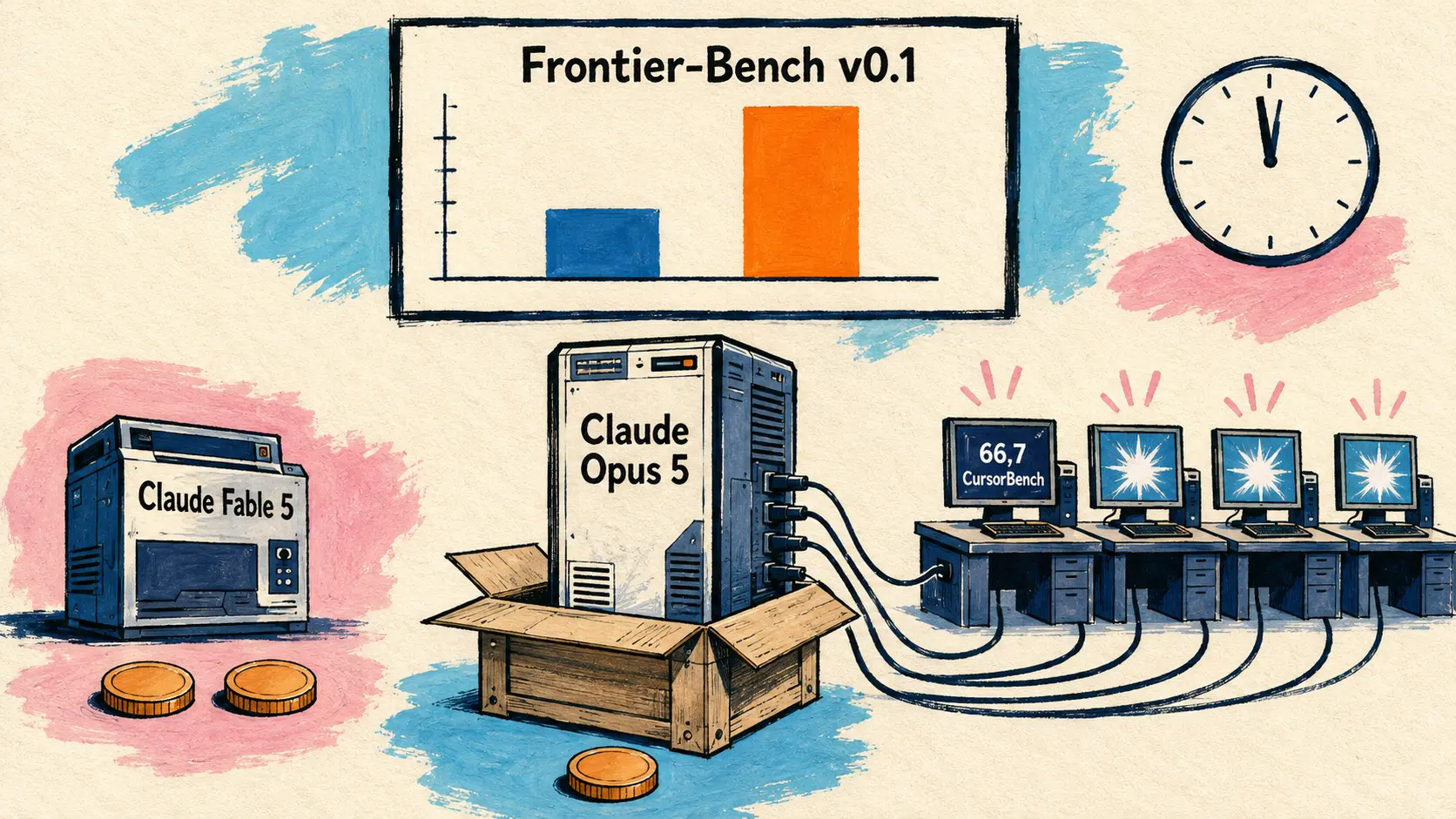
July 24 — Anthropic launches Claude Opus 5, a new model in the Claude 5 family alongside Sonnet 5 and Fable 5. Official positioning: a “thoughtful and proactive” model that comes close to Claude Fable 5 frontier intelligence — Anthropic’s most capable model — for half the price. It is available today on all paid plans and via the API (identifier claude-opus-5), at the same price as Opus 4.8: $5 per million input tokens, $25 per million output tokens. A Fast mode, about 2.5× faster, is billed at twice the base rate. Opus 5 becomes the default model on Claude Max and the most capable model offered on Claude Pro.
| Benchmark | Opus 5 result |
|---|---|
| Frontier-Bench v0.1 | Surpasses all models, more than double Opus 4.8’s score, at lower cost per task |
| CursorBench (maximum effort) | Within 0.5 points of Fable 5’s best score, at half the cost |
| ARC-AGI 3 (novel problems) | Score about three times higher than the best competitor |
| OSWorld 2.0 (computer use) | Surpasses Fable 5’s best result for about one-third of its cost |
Anthropic also reports progress in life sciences: +10.2 points in organic chemistry (molecular structure inference) and +7.7 points in predicting the effects of protein sequence variations, compared with Opus 4.8. Important nuance: these “state-of-the-art” results concern code and knowledge work — on offensive cybersecurity, Opus 5 remains intentionally behind Mythos 5 (restricted-access model): its safety classifiers block binary-method vulnerability scanning, penetration testing, and exploit generation, while still allowing vulnerability detection in source code. Anthropic estimates these classifiers will trigger about 85% less often than on Fable 5.
On alignment, Anthropic says Opus 5 is, according to its internal automated behavioral audit, the most aligned model to date (score of 2.3 on overall misaligned behavior, the lowest among its recent models). In Claude Code, it can be used immediately via /model claude-opus-5 or via /claude-api migrate to switch existing workloads, and it starts by default in high effort.
🔗 Official announcement — Anthropic
It’s a thoughtful and proactive model that comes close to the frontier intelligence of Fable 5 at half the price. — @claudeai on X
Day-one adoption in coding tools. In less than half an hour, three coding tools announce the integration within minutes of each other, followed the same day by GitHub Copilot:
| Integrating tool | Announcement time (July 24) | Differentiating detail |
|---|---|---|
| Cursor | 19:03 | Matches Fable 5 on CursorBench (66.7 vs 66.5 at default effort), half the price, compatible with Zero Data Retention |
| Devin (Cognition) | 19:07 | “Approaches” Fable 5’s level on FrontierCode 1.1, at half the cost |
| v0 (Vercel) | 19:29 | Immediately available via v0.app/?opus5 |
| GitHub Copilot | Same day | VS Code, Visual Studio, Copilot CLI, cloud agent, JetBrains, Xcode… for Pro+/Max/Business/Enterprise |
Cursor is the most precise, with exact figures and an additional advantage: compatibility with Zero Data Retention, which Fable 5 does not offer. On the GitHub side, Copilot highlights strong results on agentic coding workflows — autonomous edits, non-regression verification, coordination across multiple tools — but warns that the model includes guardrails that may block certain cybersecurity-related requests, with a recommendation to rephrase or choose another model if blocked. Copilot rollout is gradual; Enterprise and Business administrators must enable the Claude Opus 5 policy to grant access to their teams.
🔗 Cursor announces the integration
🔗 Devin announces the integration — @cognition
🔗 v0 announces the integration
🔗 GitHub Copilot — official changelog
Midjourney acquires Co-Star, first acquisition in its history
July 23 — Midjourney announces its very first acquisition: Co-Star, the personalized astrology app known for its direct tone and viral notifications. Its founder, Banu Guler, joins Midjourney as the newly created Chief Design Officer, tasked with building a cross-functional Product/Design/Frontend organization for all of the company’s projects. Co-Star continues to operate independently, entirely under its own control and leadership.
The official post, in a very personal tone, places this acquisition within a broader trajectory: it mentions Midjourney Medical as the beginning of an “unusual research lab” and announces half a dozen equally ambitious projects over the next six months. Midjourney, until now focused on image and video generation, thus signals an explicit strategic diversification beyond its historical core business. The X post, published the following day, gathered more than 426,000 views, 1,300 likes and 226 reposts in a few hours.
🔗 X post — 426,000 views in a few hours
“As an adult I find myself in the unusual position of having everything I wanted and two questions come to mind next: How can I use this opportunity to make baby David proud?” — Midjourney, official changelog
NVIDIA: Jensen Huang publishes his first X post, an open letter in defense of open models
July 24 — Jensen Huang, founder and CEO of NVIDIA, publishes his very first personal message on X: an open letter signed by NVIDIA, titled “Open Weights and American AI Leadership”, on the importance of open models (open models). In it, he states that AI “will transform every industry, power every company, and be built by every country,” and that open models strengthen safety and cybersecurity, accelerate innovation and enable sovereignty — a position that explicitly aligns NVIDIA, through its own Nemotron open-weight lineup, on the side of the open-weight ecosystem, versus closed labs like OpenAI, Anthropic or Google.
The post generated extraordinary engagement for a first personal message: more than 23.6 million views, 98,000 likes and 23,700 reposts in a few hours. Several open-weight AI players, including MiniMax, publicly thanked Jensen Huang for this position in the aftermath.
“Open models strengthen safety and cybersecurity, accelerate innovation and diffusion, and enable sovereignty. The world needs both frontier closed models and frontier open models.” — @JensenHuang on X
Workflows in Grok Build: xAI orchestrates hundreds of agents in parallel
July 23 — xAI launches workflows in Grok Build, its command-line coding agent (equivalent to Claude Code or Codex). The user describes a complex task in natural language; Grok automatically plans an orchestration script — work phases, the agents assigned to each, how their results flow back — then executes it in the background while the session remains available for something else.
| Technical parameter | Measured value |
|---|---|
| Default agents | 128 |
| Maximum agents (large tasks) | 1024 |
| Highlighted demo | 4-phase GitHub pull request review (Context → Review → Verify → Synthesize) |
| Live tracking | Command /workflows |
The specialized reviewers in the demo have their conclusions adversarially checked by independent “skeptics” before landing in the final report. Progress is saved continuously — pause and resume never require redoing work already completed. Workflows can be saved and reused: those placed in .grok/workflows/ are shared with the team, those in ~/.grok/workflows/ follow the user everywhere, and each saved workflow becomes its own parameterizable slash command (for example /pr-review 5137). The /deep-research feature, which splits a research question among multiple investigators in parallel and verifies each claim against its sources, is included natively.
Use cases highlighted by xAI: review every feature in a large pull request, sort the last 100 Linear tickets to derive an action list, or audit every route handler in a codebase for missing authentication checks.
The coding ecosystem: less prompting, more agents
Claude Code: Anthropic removes 80% of the system prompt for Claude 5 models
July 24 — Thariq (@trq212), from the Anthropic team, publishes an article detailing the evolution of Claude Code’s context engineering: Anthropic has removed more than 80% of Claude Code’s system prompt for Claude 5 models like Opus 5 and Fable 5, with no measurable loss on code evaluations. The old system prompts imposed rigid rules — for example never write multi-line comments — that had become unnecessary, since newer models have better judgment to resolve contradictory instructions depending on context. The article formalizes six doctrine changes, including: give strict rules → let Claude decide; put everything upfront in the prompt → progressive disclosure. Anthropic provides these practices through a new command, /doctor, which helps audit and resize a project’s skills and CLAUDE.md files.
v0 turns a complete Figma file into an app
July 24 — v0 (Vercel) expands its Figma integration, until now mostly focused on importing isolated components: from a simple link, the agent automatically explores all pages and frames in the file, selects the relevant elements — design tokens, colors, layout, text, icons — then assembles the identified screens into a single coherent app, without manual frame-by-frame selection. The official documentation details all the data extracted on the dedicated v0 Docs page.
Copilot cloud agent for Linear reaches general availability
July 23 — GitHub moves Linear issue assignment to Copilot cloud agent into general availability: once assigned, the agent analyzes the issue, opens a draft pull request in an ephemeral environment powered by GitHub Actions, surfaces its progress in the Linear timeline, then requests a review. New compared with the preview: model choice and custom agent directly from Linear, target branch definition, and session control via a simple comment. Available with Copilot Pro, Pro+, Business and Enterprise plans.
GitHub MCP Server anticipates the next MCP specification
July 23 — The MCP (Model Context Protocol) becomes stateless starting July 28, 2026, and GitHub MCP Server already supports this new specification ahead of its official publication. The result: removal of Redis sessions, faster connections without an initialize step, and an upgraded elicitation implementation using separate HTTP requests. Since Level 1 SDKs keep backward compatibility, no action is required on the client side.
Sakana AI releases Fugu-Ultra v1.1 and a Claude Code-compatible interface
July 24 — Sakana AI releases an update to its multi-model orchestration engine Fugu-Ultra (v1.1), with gains of up to 7.9 points over v1.0, especially strong on ProgramBench and Terminal Bench 2.1. Sakana claims better performance than Fable 5 in complex coding and reasoning, without even including the latter in its pool of orchestrated models. In parallel, Sakana exposes Claude Code-compatible endpoints to use Fugu’s multi-agent intelligence directly from this client rather than relying on a single model.
🔗 Official announcement — Sakana AI
Google / Gemini: Spark expansion, security fix for Gemini CLI
Gemini Spark rolled out to Google AI Pro subscribers in the United States
July 23 — Gemini Spark, Google’s personal AI agent that works in the background 24/7 to carry out tasks under the user’s direction, is taking a step toward wider availability: after Google AI Ultra subscribers, it is now beginning to roll out to the much larger Google AI Pro tier, initially in the United States. Google says expansion to more countries is coming “soon.” This is not a new feature in the strict sense, but a change in audience that brings a premium-style autonomous agent closer to the paying public at large.
Gemini CLI v0.53.0-preview.0 fixes an RCE flaw
July 22 — A new preview release of Gemini CLI (not yet listed in the official stable changelog), with two security-related fixes: strengthening task isolation and workspace trust in the Agent-to-Agent server to prevent arbitrary code execution (RCE), and mitigating prompt injection loops and infinite ReAct loops. It also adds an LLM-based triage orchestrator and hardens Seatbelt profiles on macOS toward a deny-by-default model.
🔗 GitHub release v0.53.0-preview.0
OpenAI: ChatGPT Work connects to protected sites, a diagnosis corrected thanks to ChatGPT
ChatGPT Work can now connect to sites requiring authentication
July 24 — The ChatGPT Work agent can now use sites that require a login: the user takes control of the cloud browser long enough to authenticate, then lets the agent resume the task automatically. Key point: the login persists from one session to the next, with a single authentication enough for subsequent tasks on the same site — a classic limitation of web-browsing agents thus removed. This development broadens the scope of automatable tasks to include internal enterprise tools and SaaS protected by credentials.
How ChatGPT helped correct a cancer diagnosis
July 24 — OpenAI Newsroom рассказывает how Kiley’s husband, after she was diagnosed at 18 with a glioblastoma with a prognosis of a few months and is still alive five years later without a clear explanation, used ChatGPT to decipher a recent radiology report. This reading led back to the initial biopsy results, where ChatGPT helped surface a detail that had gone unnoticed: an IDH1 mutation. In consultation with Kiley’s neuro-oncologist, this detail made it possible to reclassify the diagnosis as IDH-mutant astrocytoma — still serious, but with a much more favorable prognosis.
NVIDIA & generative video: faster infrastructure, more collaborative agents
NVIDIA cuts DeepSeek-V4 Pro startup time from 8 minutes to under 2 minutes
July 24 — NVIDIA details an inference infrastructure optimization: the startup time for a DeepSeek-V4 Pro deployment drops from 8 minutes to under 2 minutes by sending model weights to GPU memory through the fastest path via GPU-to-GPU RDMA. The mechanism relies on NVIDIA ModelExpress, the weight distribution and cache management service integrated into NVIDIA Dynamo, its distributed inference platform. NVIDIA notes that the same approach also speeds up reinforcement post-training.
Runway adds natural-language Workflows to its agent
July 24 — Runway adds a Workflows feature to Runway Agent: it is now possible to build, run, or modify node-based workflows directly in natural language, rather than by manually manipulating a visual editor. Distinct from the Media Router launched the day before — which handles automatic selection of generative models based on cost, quality, and latency — Workflows tackles the orchestration of production steps themselves.
HeyGen — Companion mode: directing the video rather than commanding it
July 22 — HeyGen introduces companion mode for its Video Agent: instead of commanding a video with a single prompt, the user directs it iteratively — the agent proposes five creative angles, presents a storyboard for approval, then sketches the key images to review before final generation. The user stays in control at every step and only launches full production after approval. This feature responds to a common criticism of “one-shot” video generators — unpredictable results, iterations that are expensive in time and credits — by bringing the experience closer to collaborating with a human director.
Genspark: Microsoft partnership and $100 million investment in Japan
SecondBrain integrates with Outlook, Teams, and Microsoft Agent 365
July 24 — At the launch of Genspark 6.0 in Seoul, Genspark details a strategic partnership with Microsoft: SecondBrain, the persistent-memory layer for its agents, now integrates directly into Outlook, Office, Teams, as well as Microsoft Agent 365 — of which Genspark says it was a global launch partner. The whole stack runs on Azure, presented as ensuring the robustness expected in an enterprise environment. The post specifically thanks Satya Nadella (Microsoft CEO), Judson Althoff, and Rodrigo Kede. This part did not appear in the original launch post on July 20.
Genspark invests $100 million over 3 years in Japan
July 24 — Following an event held in Tokyo on July 21 in front of enterprise customers, industry partners, and Japanese influencers — Genspark’s second in the country — the company announces a $100 million investment over the next three years in Japan, just six months after opening its local business. Three priorities: data residency for eligible customers (financial institutions, government agencies, large enterprises), end-to-end partnerships with resellers and integrators, and strengthening local teams in the customers’ own language and time zone.
Grok arrives in Google Workspace
July 24 — xAI launches a free add-on that brings Grok directly into Sheets, Slides, and Docs, installable from the Google Workspace Marketplace. In Sheets, Grok answers questions by citing the cells it used and writes formulas; in Slides, it turns an outline into a presentation while preserving the existing theme; in Docs, it drafts and edits in place, with access to recent emails and Drive files if the connectors are enabled. This integration completes the suite already available on the Microsoft 365 side (Word, Excel, PowerPoint, Outlook), launched between June and July.
Briefs
- Replit recaps its monthly updates — voice agent, creation from Claude or Slack, persistent stack memory; at least one of the cited capabilities appears to overlap with an integration already published on June 17. 🔗 Source
- Kimi K3 nearly tied with Claude Fable 5 on DeepSWE — pass@1 within 1.4 points, but ahead on pass@2/pass@4, at 2.8× lower cost per solved task (Together AI). 🔗 Source
- Collective statement on open models as a path to AI security — coalition of around fifteen organizations including Hugging Face, Meta, Mistral AI, NVIDIA, and Microsoft, reposted by the official @huggingface account. 🔗 Source
- HeyGen launches an Audio to Video API — voice and image to video in a single call, with batch processing (e.g. 100 narrations on the same image). 🔗 Source
- ElevenLabs publishes a post on AI voice and election protection — institutional positioning ahead of major electoral deadlines. 🔗 Source
- HeyGen — HyperFrames, day 18 of 30 — a new episode in the daily series, focused on its use in Video Agent. 🔗 Source
- Zvec 0.6.0, Tongyi Lab’s vector search engine (Alibaba) — Group-By search, more than 50 recall points gained with INT4 quantization, support expanded to 34 languages. 🔗 Source
- xAI multiplies third-party plugins in Grok Build — Tavily and Exa for web search, Grok STT available on OpenRouter at $0.10 per audio hour. 🔗 Source
- ChatGPT Pet becomes shareable between users — shareable link from the Personalization settings on the web, so another user can adopt the pet. 🔗 Source
What this means
The launch of Opus 5 illustrates a structural shift in the way frontier models reach their users: Cursor, Devin, and v0 integrate it in less than half an hour, GitHub Copilot the same day. The release → adoption cycle, which only recently was measured in weeks, is now almost zero for the code tools best connected to the Anthropic ecosystem — a dynamic that shortens the differentiation window between labs accordingly and shifts competition toward integration speed as much as raw model performance.
On the same day, a counter-narrative is expressed with the same intensity. Jensen Huang publishes his very first personal post on X to defend open models as a path to security and sovereignty; a coalition of around fifteen organizations, including Hugging Face and Meta, issues a similar statement; and Sakana AI claims to surpass Fable 5 by orchestrating multiple models without even including it in its pool. Two visions of AI security — one based on proprietary control, the other on weight transparency — publicly clash on the same day, with neither visibly gaining the upper hand over the other.
Cybersecurity also continues to function as a marker of deliberate caution rather than raw performance. Anthropic intentionally positions Opus 5 behind Mythos 5 on offensive tasks, with dedicated classifiers that block vulnerability scanning, intrusion testing, and exploit generation. At the same time, Google is fixing an arbitrary code execution flaw in Gemini CLI on the agent-to-agent server side — a reminder that agentic tools themselves, not just the models they embed, remain an attack surface that must be continuously secured.
Sources
- Claude Opus 5 — Official Anthropic announcement
- Claude Opus 5 — @claudeai announcement thread
- Claude Opus 5 in Cursor — @cursor_ai
- Claude Opus 5 in Devin — @cognition
- Claude Opus 5 in v0 — @v0
- Claude Opus 5 in GitHub Copilot — Changelog
- Claude Code — 80% of the system prompt removed, @trq212
- Midjourney acquires Co-Star — Official changelog
- Midjourney — X relay
- Jensen Huang — Open letter on open models
- Workflows in Grok Build — xAI
- v0 — Figma to app
- Copilot cloud agent for Linear — GA
- GitHub MCP Server — upcoming MCP specification
- Sakana AI — Fugu-Ultra v1.1
- Gemini Spark — US Pro extension
- Gemini CLI v0.53.0-preview.0
- ChatGPT Work — authentication
- OpenAI Newsroom — Kiley’s story
- NVIDIA — Dynamo ModelExpress
- Runway — Workflows
- HeyGen — Companion mode
- Genspark — Microsoft partnership
- Genspark — Japan investment
- Grok in Google Workspace — xAI
- Replit — monthly recap
- Together AI — Kimi K3 vs Claude Fable 5
- Collective statement on open models
- HeyGen — Audio to Video API
- ElevenLabs — AI voice and elections
- HeyGen — HyperFrames day 18/30
- Zvec 0.6.0 — Tongyi Lab
- xAI — third-party plugins in Grok Build
- ChatGPT Pet — sharing