ai-powered-markdown-translatorArticle translated from fr to en with gpt-5.4-mini.
July 23, 2026 brings together seven major announcements: OpenAI rolls out Health in ChatGPT to users in the United States and brings ChatGPT Voice to the desktop app, Black Forest Labs unifies image, video, audio, and action prediction in FLUX 3, GitHub for the first time puts guardrails around what its agents change on their own in Issues, HeyGen turns its HyperFrames framework into a full video-creation agent, and Cognition expands its footprint with the acquisition of Poke and then a memorandum of understanding with the U.S. Department of Energy. Around these seven topics, eighteen other notable updates are orbiting — from Claude’s voice mode to code tools (Cursor, Replit, Zed, v0, Amp), not to mention cyberdefense at Gemini and Hugging Face.
Health in ChatGPT arrives in the United States
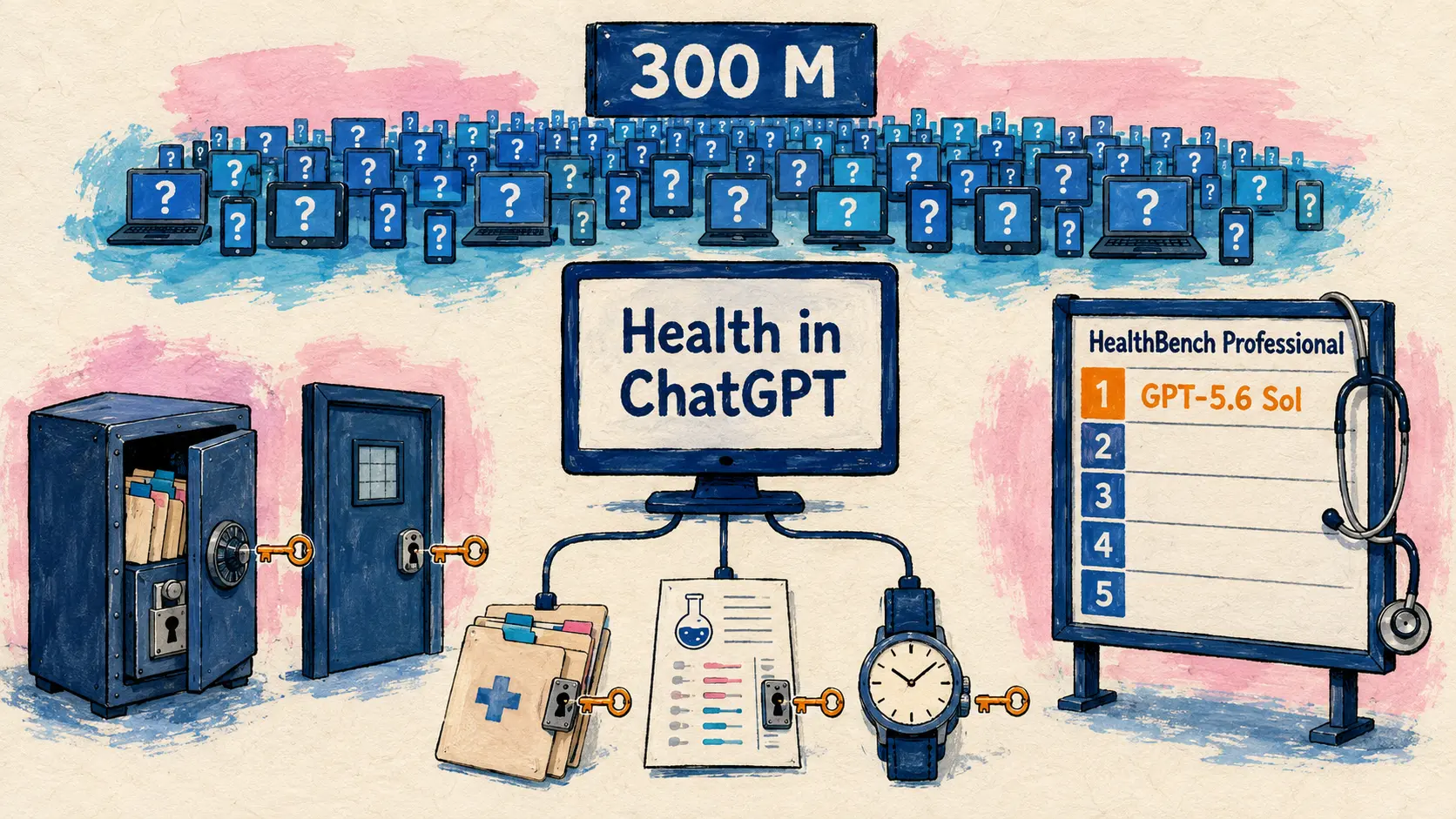
July 23 — OpenAI is rolling out Health in ChatGPT to signed-in U.S. users, ages 18 and up, on web and iOS, for Free, Go, Plus, and Pro plans. The feature lets people securely connect Apple Health as well as supported medical records (U.S. hospital systems, One Medical, Function Health), so ChatGPT has the user’s health context — comparing a lab result with earlier tests, summarizing what has changed since a recent appointment, or cross-referencing sleep and activity with daily routine.
OpenAI highlights one number: more than 300 million people ask ChatGPT health-related questions every week. The company says it is working with hundreds of doctors to measure and improve accuracy, safety, and recognition of situations that require professional care. On the model side, GPT-5.5 Instant (free plan) provides a common baseline for all users, while GPT-5.6 Sol (paid plans) goes further on complex questions; on HealthBench Professional, the evaluation developed with doctors, all GPT-5.6 models outperform GPT-5.5.
On privacy, OpenAI is clear: connected medical records and Apple Health data, as well as the conversations that use them, are never used to train the models or to target advertising, regardless of any other training setting chosen by the user. By default, ChatGPT asks permission before each use of this data; disconnecting an account deletes synced data within 30 days. One notable point: Health is not available in Codex. An earlier version, released earlier this year, confined these exchanges to a dedicated space — but more than 70% of health-related conversations were happening elsewhere, hence the native integration across all conversations.
🔗 Official announcement — OpenAI
FLUX 3: Black Forest Labs unifies image, video, audio, and action prediction
July 23 — Black Forest Labs (BFL), the creators of the FLUX image models, announce FLUX 3, presented as a single multimodal model trained in a unified architecture rather than as separate models stitched together afterward. The company highlights a render that is “more faithful to reality across all styles” compared with previous generations.
| Covered modality | Status on July 23 |
|---|---|
| Image | Available |
| Video (FLUX 3 Video) | Early access, available today |
| Audio | Integrated into the unified architecture |
| Action prediction | Robotics work with mimic and Audi |
Two parts set this release apart. First, FLUX 3 Video expands BFL’s historic scope — previously centered on still images — into video, a field so far dominated by Runway, Luma, Kling, or Wan. Second, BFL says the model’s unified architecture can be extended to predict physical actions, with work carried out in collaboration with mimic (a specialist in teleoperation and robotic learning) and Audi — a dimension that brings BFL closer to physical AI territory, where NVIDIA is heavily investing with Cosmos and Isaac.
The announcement post gathered more than 393,000 views in a few hours, with a follow-up thread showing the first FLUX 3 Image samples. It is the most notable model launch in the generative media segment in this window, both for its ambition — one model for four modalities — and for its opening toward robotics.
ChatGPT Voice steers Chat, Work, and Codex by voice
July 23 (9:43 PM) — OpenAI announces the arrival of ChatGPT Voice in the desktop app (macOS and Windows), for Plus, Pro, Business, Edu, and Enterprise plans, rolling out worldwide starting today. Powered by GPT-Live, the feature lets users control their computer and direct multiple agents — ChatGPT Work or Codex — using voice only: the model speaks, listens, and coordinates work in the app at the same time.
ChatGPT Voice is now in the desktop app. Control your computer and direct multiple agents running in ChatGPT Work or Codex, using just your voice. It’s powered by GPT-Live, so it can speak, listen, and coordinate work in the app at the same time. Rolling out globally today on macOS and Windows to Plus, Pro, Business, Edu, and Enterprise plans. — @OpenAI on X
The official Codex changelog (version 26.715) adds a detail missing from the tweet: on macOS, a “Screen context” option lets users share a capture of the foreground window with ChatGPT during a voice conversation, so the assistant can see what the user is looking at while working out loud. A follow-up tweet says ChatGPT Voice can also be used in Codex from the iOS app, via a paired remote connection — Android support is announced as “coming soon” with no date specified.
🔗 Codex Changelog — version 26.715
Claude’s voice mode is getting richer too
July 23 — Anthropic is updating Claude’s voice mode, available on all plans. It now relies on more capable models — Opus and Sonnet — rather than a lighter dedicated model, for deeper spoken exchanges.
Voice mode now runs on Claude’s more capable models and reaches the tools you’ve connected mid-conversation. Talk through the hard problems out loud, in many more languages. — @claudeai on X
Claude can also now access, in conversation, tools already connected to the account (messaging, calendar) without interrupting the user. Voice mode gains Spanish, French, Hindi, and Japanese, in public beta starting today on mobile, desktop, and web.
Codex: projects that span multiple folders
July 23 (10:31 PM) — In the same release as ChatGPT Voice (Codex changelog 26.715), Codex introduces multi-folder local projects in the ChatGPT desktop app. A local project can now group code, documentation, and reference files spread across several folders; Codex can read and write across the whole set, while one primary folder remains the Git root.
From a project’s menu, the “Edit project” option lets users add folders and designate the primary folder. New chats, Git operations, automatic discovery of AGENTS.md, skills, and the config.toml file all use the primary folder; secondary folders remain available for file search in both read and write.
GitHub puts guardrails around agents that modify Issues
July 23 — GitHub has launched a public preview of a set of controls designed to frame agent automations on GitHub Issues. The starting observation: agents (GitHub Agentic Workflows, Copilot cloud agent) increasingly label, classify, assign, and close issues automatically, without teams always being able to understand why or easily keep control.
| Added capability | What it does |
|---|---|
| Approvals | Automation suggests rather than applies; changes wait for validation, one by one or in a batch |
| Confidence score | Each action gets high / medium / low confidence; only high applies automatically |
| Justification | Each action records its reason, applied or pending — a viewable audit trail |
The has:suggestions search finds issues with changes waiting for review; administrators set the confidence threshold that determines what is applied automatically. These controls work with GitHub Agentic Workflows (by adding issue-intents: true to the workflow frontmatter) and with Copilot cloud agent (no update required). At launch, the covered actions are: labels, custom fields, type, closing, and assignment, via the REST and GraphQL APIs.
A cautionary note from GitHub itself: approvals are described as “a workflow convenience, not a security control” — they do not enforce a server-side barrier, and an agent with the necessary permissions can still apply a change directly rather than suggesting it. Highlighted use cases include automatic triage, metadata enrichment, and spam detection with justification.
GitHub Mobile fixes your CI failures with Copilot
July 23 — GitHub extends to the mobile app (iOS and Android) the Fix with Copilot feature, already available on pull request comments. Now, when a GitHub Actions check fails on a pull request, a Fix with Copilot button appears directly on the failing check from GitHub Mobile.
With one tap, Copilot coding agent analyzes the failure, opens a new pull request on top of the existing pull request with a proposed fix, then notifies the user for review. The stated goal is to let users react to CI failures on the go, without going back to a workstation, so pull requests keep moving even away from the keyboard.
Runway automates generative model selection
July 23 — Runway launches Media Router, described as the first media generation router “optimized by preference.” Rather than manually choosing a model for each request, the user defines once what “best” means — cost, quality, or latency — and the router automatically selects the appropriate video, image, or audio model.
The feature is available now in Runway Dev, the developer platform launched alongside it. This is an infrastructure layer rather than a new model: it targets product teams orchestrating multiple third-party generative models and looking to automate the cost/quality/latency tradeoff — an approach similar to LLM routers (OpenRouter and others) but applied to generative media.
HeyGen turns HyperFrames into a video-creation agent
July 23 — HeyGen moves HyperFrames — previously best known to the general public through its daily creative series — from a simple HTML rendering engine to a central product: Video Agent, directly integrated into HeyGen. The idea: the user describes what they want, and the agent builds the entire video end to end — avatar, graphics, subtitles, and music, all presented as “infinitely customizable.”
The launch is accompanied by a viral growth operation (one free month of HeyGen in exchange for interacting with the post) that generated more than 1.1 million views, 810 replies, and 788 reposts in a few hours — by far the most-viewed post in the entire scan window on the generative media segment.
Notable for developers: alongside the consumer product, HeyGen open-sources HyperFrames itself on GitHub (repository heygen-com/hyperframes, described as “Write HTML. Generate a video. Built for agents.”), which lets third-party agents generate video from HTML even outside the HeyGen app. The same thread also announces a new large-scale video translation API (see Briefs). This is therefore a dual product and developer-platform move in a single day for HeyGen.
Cognition acquires Poke, the agent that lives in your messages
July 23 — Cognition (Devin) announces the acquisition of The Interaction Company of California, the publisher of Poke, a conversational personal agent that lives directly in the user’s messages. According to the post signed by Scott Wu, CEO and cofounder of Cognition, he and Walden (Cognition cofounder) were early angel investors in Interaction, and the two teams already shared the same technical bet: always-on cloud agents.
Poke is a personal agent that lives in your texts. It messages you first, follows up with you, and feels less like software and more like a friend. People have exchanged more than 100 million messages with it in just the last three months, and it’s the only AI agent approved to text natively on Apple Messages. — Scott Wu on the Cognition blog
For users, nothing changes immediately — Poke continues to work as before — but Cognition says it wants to bring its models and infrastructure to make it “faster and more reliable.” The deal positions Cognition beyond its historic core business (the autonomous software engineer Devin) toward consumer personal agents, a new strategic direction for the company.
Cognition Joins the Department of Energy’s Genesis Mission
July 22 — Cognition has signed a memorandum of understanding (MOU) with the U.S. Department of Energy (DOE) to join the Genesis Mission, a national initiative launched by presidential decree in November 2025 and described as “America’s Manhattan Project for AI.” It brings together the 17 U.S. national laboratories, industry, and academia to connect the country’s most powerful supercomputers to the largest federal scientific datasets, with the stated goal of doubling U.S. scientific research productivity within a decade. Cognition thus joins Google DeepMind, OpenAI, and Arcee AI, whose participation in the same mission was already covered the day before, on July 22.
| Engagement area | Devin’s contribution (Cognition) |
|---|---|
| Software and data security | Find and fix vulnerabilities in scientific codebases |
| Legacy code modernization | Documentation, tests, and translation of old code (Fortran, C++, COBOL) |
| Expanding research capacity | Delegate data pipelines, infrastructure, and deployment |
| Cloud modernization | Migrate legacy applications to cloud-native platforms |
The post notes that the Cognition platform is undergoing FedRAMP Class D (High) qualification, that Devin Desktop and Devin CLI are already certified at this level and compliant with ITAR/IL4-IL6, and that Devin is already used by the US Army, the US Navy, and NASA’s Jet Propulsion Laboratory. As part of its membership, Cognition is offering code security scans and remediation reports in kind for the national laboratories, as well as additional compute for teams selected through Genesis Mission calls for proposals.
Coding tools are speeding up
Five notable updates affect AI-assisted development tools this week, spanning pricing, features, and event-driven automation.
Cursor doubles its usage limits
July 21 — Cursor is doubling the included usage limits across all individual and Teams plans (Enterprise excluded, not mentioned). The change applies to Grok models (xAI) and Composer (Cursor’s proprietary model), as well as any future Cursor model, with no pricing change announced beyond the “doubled” factor. The post generated significant engagement — around 1,000 reposts and 10,000 likes in a few hours — a sign of a very positive reception from the community. This announcement is distinct from Cursor Router, released the day before.
Replit cuts hosting prices by more than half
July 23 — Replit announces a substantial price cut — more than 50% — on hosting for apps published at scale, effective starting August 1, 2026. Any published app runs on Replit Cloud, with automatic scaling based on usage, authentication and secure database included, and built-in analytics and SEO. The new prices apply automatically to all users at their next monthly billing cycle, with no action required on their part.
Zed 1.12: Git Panel and multi-select
July 22 — Zed releases stable version 1.12: the Git panel now offers separate “Staged” and “Unstaged” sections, and clicking an entry in either group opens the corresponding multibuffer. The File Finder and Text Finder also support multi-select (cmd-click on macOS, ctrl-click on Linux/Windows, or tab) to open several files at once. A CSV filtering feature initially mentioned in the thread was ultimately removed in a correction from Zed, which clarified that the feature was not actually public yet.
v0: slash commands, Shopify for everyone, Snowflake reliability
July 21 — v0 (Vercel) adds slash commands: typing / in the composer opens a menu to attach a skill via skills.sh without leaving the keyboard. The Shopify integration, which generates an e-commerce storefront that reads products, prices, and inventory live, is now open to all users. A reliability pass on Snowflake detects code changes since the last deployment and directs generations to the connected account rather than to dummy data.
Amp: orbs react to external events
July 23 — Amp “orbs” (cloud sandboxes for remote agents) can now wake up on external events via a new webhooks API (amp.createWebhook): CI failure on GitHub, new Linear issue, monitoring alert, Discord message. Amp verifies the provider signature and deduplicates deliveries; the external event remains untrusted data, never interpreted as a direct instruction to the agent. Example uses cited: investigate every CI failure on the main branch and post the results on Slack, or monitor new dependency releases to automatically open an update pull request.
Cyber defense: Gemini and Hugging Face arm defenders
Two separate announcements from the period converge on the same need: better tools for defending against software vulnerabilities.
Gemini 3.5 Flash Cyber detects 72% of vulnerabilities
July 23 — Following the grouped announcement on July 21 (Gemini 3.6 Flash, 3.5 Flash-Lite, 3.5 Flash Cyber), Google DeepMind publishes a dedicated thread with a quantified benchmark for Gemini 3.5 Flash Cyber, a lightweight model specialized in finding and fixing vulnerabilities.
| Tested model | Detection rate |
|---|---|
| Gemini 3.5 Flash Cyber | 72% |
| Gemini 3.5 Flash (standard) | 55% |
| Claude Opus 4.6 (Anthropic) | 54% |
The test — dubbed the “Chrome Production Commit Scanning Pipeline” — was conducted on the real codebases of Chrome and Android, where the model detected complex vulnerabilities missed by standard models. Availability remains a limited-access pilot, reserved for governments and trusted partners, presented by Google as part of a “responsible deployment” approach.
The Stack v3, the open-source fuel for cyber defense
July 23 — Leandro von Werra, Head of Research at Hugging Face, announces The Stack v3, the new generation of the organization’s code dataset HuggingFaceCode (the source of the StarCoder models): 5 trillion tokens ready for training, 120 TB of raw data, more than 700 programming languages, under the ODC-BY license. The messaging angle is explicitly defensive — von Werra justifies the release by citing an urgent need for “good open code models for cyber defense,” echoing Sakana AI’s release of Fugu-Cyber the day before.
Together AI and NVIDIA equip inference and fine-tuning
Together AI launches a new generation of its inference platform
July 23 — Together AI announces Together Dedicated Model Inference, a redesign of its inference platform for open-weight models. On the menu: multiple deployments behind a stable endpoint, secure rollouts (canary, blue-green, rolling with automatic rollback), A/B tests and “shadow traffic” on real traffic, starts about 4x faster thanks to a new cache layer (frontier MoE models like Kimi K2.7, MiniMax M3, or GLM 5.2 deployed in 7 to 14 minutes), and a closed beta for custom fine-tuning (full-weight RL, LoRA, SFT) with direct deployment of checkpoints to production. A presentation webinar is scheduled for August 6.
NVIDIA: RL fine-tuning for under $5
July 23 — NVIDIA highlights a reinforcement-learning fine-tuning demo hosted on Nemotron 3 Nano, carried out with Prime Intellect Lab: accuracy improved from 22% to 91% on a math task, at a cost of less than $5. The full flow — baseline, training to reward convergence, validation retest — ends with a downloadable LoRA adapter, transferable to Nemotron 3 Super and Ultra by changing a single configuration line.
Gemini Notebook organizes your notebooks with Collections
July 20 — Gemini Notebook (formerly NotebookLM) launches Collections, a new tab for organizing notebooks like photo albums or playlists rather than through a classic folder tree: no rigid structure, and the same notebook can belong to as many collections as desired, or to none.
This is a shipped feature — a new tab visible in the product — not just a teaser. Dated the day before the strict window for this scan, the tweet nevertheless answered a recurring user request that had gone unanswered until now.
🔗 Pinned tweet @Gemini_Notebook
xAI and Qwen expand their offerings
Grok 4.5 available across all consumer surfaces
July 22 — xAI announces that Grok 4.5 now powers Grok across all of its consumer surfaces: grok.com, X, and the iOS and Android apps. The model is also still available through Word, Excel, PowerPoint, and Outlook via xAI’s Microsoft 365 add-ins. This is not a new model: its flagship launch was already covered on July 8, and its full availability in Europe on July 16 — this announcement is the final link in the rollout, the effective switch on mobile and the consumer website.
Grok arrives in Microsoft Outlook
July 21 — xAI expands Grok’s integration with Microsoft 365 with Grok for Outlook: an agent that summarizes long threads, drafts replies in the user’s style, archives finished conversations, and flags what still needs a response — nothing is sent without explicit approval. Available starting today for paid X and SuperGrok subscribers via the Microsoft Marketplace, this module joins those already offered for Word, Excel, and PowerPoint.
Qwen Cloud launches the Token Plan Individual
July 21 — Qwen Cloud launches Token Plan Individual, a subscription starting at $6 per month that provides access to a unified credit pool for the Qwen family as well as GLM and DeepSeek, with early access to Qwen3.8-Max-Preview (a model already covered on July 19). The promotional infographic details three pricing tiers (Lite / Standard / Pro), off-peak discounts, and a pool that can power up to 8 agents simultaneously.
Anthropic invests $200 million in AI economic futures
July 22 — Anthropic unveils the research agenda for its Economic Futures Research Fund, backed by $200 million to finance ambitious external research on interventions that can prepare society for the economic impacts of AI. Five priority areas: impact on workers, support for career transitions, modernization of income support systems, mechanisms for sharing AI-driven growth (pre-distributive capital accounts), and new data on public investment.
Anthropic plans to fund mainly projects between 30 million, open to universities, independent research institutes, and nonprofit organizations — not individual researchers. This fund evolves the “Economic Futures” program launched a year earlier, refocusing on a smaller number of ambitious grants rather than many small ones.
Briefs
- **Anthropic doubles its support for Public First Action (40 million for this nonpartisan public education organization focused on AI issues; these donations fund only the education and public policy mission, with no electoral support possible. 🔗 Source
- Claude Code: guide to verification loops built with skills — how to turn manual checks into Claude Code skills so Claude can loop through its own verification. 🔗 Source
- Outtake case study: a cyber investigation agent built on Claude — how Outtake runs multi-hour sessions to map attack networks. 🔗 Source
- Cognition — DeepWiki surpasses 500,000 indexed repositories — free AI-generated code documentation tool; meetup with LangChain announced for July 28 in San Francisco. 🔗 Source
- Replit highlights Firecrawl integration — one-click web context for apps, with 10,000 credits offered to early users. 🔗 Source
- Hugging Face natively integrates Nunchaku (SVDQuant) into Diffusers — 4-bit quantized checkpoints (weights and activations) now load via
from_pretrained(), without a separate inference library. 🔗 Source - Together AI will host Kimi K3 (Moonshot AI) at launch on July 27 — inference available on day zero, benchmarks shared after the actual launch. 🔗 Source
- Gemini CLI v0.52.0 — triage and egress services, LLM correction bypass for JSON/IPYNB in
write_file/replace, update ofgoogle-auth-libraryto version 10.9.0. 🔗 Source - GitHub — multi-select fields for Projects and Issues — a custom field can now contain multiple values at once (teams, modules, categories). 🔗 Source
- HeyGen — video translation API at scale — duplicate an entire video chain into 10 localized versions in under 24 hours, with batch processing. 🔗 Source
- Codex Sites Analytics enters public testing — basic performance metrics for sites published with Codex. 🔗 Source
- OpenAI launches the “ChatGPT for small businesses” program — ChatGPT Work webinars, AI academies in the United States, partnerships with Dropbox, Shopify, Intuit, Slack, Atlassian, and Wix. 🔗 Source
- David Vélez (Nubank) and Robin Vince (BNY) join OpenAI’s boards of directors — the OpenAI Foundation and OpenAI Group PBC welcome the two executives. 🔗 Source
- Cohere announces a partnership with HUMAIN for Arabic AI — a follow-up to the success of Cohere Transcribe Arabic, with no product or date specified for now. 🔗 Source
What it means
Voice is establishing itself as a full-fledged control interface on the same day for two different players. ChatGPT Voice is arriving on desktop to run Chat, Work, and Codex without a keyboard, powered by GPT-Live; Claude, for its part, is running its voice mode on its most powerful models and giving it access to connected tools during the conversation. The two announcements are independent, but the convergence in timing is probably no coincidence: it reflects the same bet — spoken conversation is becoming a full work channel, capable of triggering real actions via agents or connected tools, rather than just a gimmicky assistant that merely answers questions.
Framing agents is becoming a topic in its own right, separate from simply running them. GitHub is introducing approvals, a trust score, and a justification for changes that its agents apply on their own to Issues — while itself specifying that this is “not a security control,” just a workflow convenience. Runway, for its part, is adding an automatic arbitration layer (cost, quality, latency) between competing generative models. The common thread: as agents gain autonomy, vendors are adding governance and control layers rather than simply stacking capabilities — a shift also seen in Codex’s multi-folder projects, designed so agents can work across a broader scope without losing the notion of a source of truth, the primary Git folder.
Cyber defense is emerging as an explicit axis of competition among major AI players. Gemini 3.5 Flash Cyber claims 72% vulnerability detection on real Chrome and Android codebases, versus 55% for its own standard model and 54% for Claude Opus 4.6 named explicitly by Google — a direct comparison that is rare enough to be worth noting. That same day, Hugging Face releases The Stack v3, a 5-trillion-token code dataset, explicitly justifying the release by the need for “good open code models for cyber defense.” These two independent announcements outline a shared concern about the exploitation of software vulnerabilities at scale, and a symmetrical response: specialized closed models on one side, open data to train others on the other.
Cognition is expanding its playing field in both directions in a single week. The acquisition of Poke, a personal agent that lives in the user’s messages and has exchanged more than 100 million messages in three months, shifts the company’s center of gravity beyond Devin, its autonomous software engineer, toward consumer-facing agents. At the same time, its memorandum of understanding with the US Department of Energy for the Genesis Mission places it alongside Google DeepMind, OpenAI, and Arcee AI — already engaged in that same initiative since July 22 — in a now four-way race to establish a foothold in American public scientific research. Two moves, one logic: consolidate a position both with consumers and within institutional infrastructure, rather than remaining confined to a single segment.
Sources
- Health in ChatGPT
- FLUX 3 — Black Forest Labs
- ChatGPT Voice desktop
- Codex changelog 26.715
- Claude voice mode
- Anthropic blog — voice mode
- Codex — multi-folder projects
- GitHub — agent controls in Issues
- GitHub Mobile — Fix with Copilot
- Runway Media Router
- HeyGen Video Agent
- Cognition acquires Poke
- Cognition — X announcement
- Cognition — Genesis Mission DOE
- Cursor — doubled limits
- Replit — hosting pricing
- Zed 1.12
- v0 — changelog
- Amp — eventful orbs
- Gemini 3.5 Flash Cyber
- The Stack v3 — Hugging Face
- Together AI — inference platform
- NVIDIA — Nemotron fine-tuning
- Gemini Notebook — Collections
- Grok 4.5 — everywhere
- Grok for Outlook
- Qwen Token Plan Individual
- Anthropic — Economic Futures Research Fund
- Anthropic — Public First Action donation
- Claude Code — verification loops
- Outtake case study
- Cognition — DeepWiki
- Replit — Firecrawl
- Hugging Face — Nunchaku Diffusers
- Together AI — Kimi K3
- Gemini CLI — changelog
- GitHub — multi-select fields
- HeyGen — Video Translation API
- Codex Sites Analytics
- OpenAI — small business program
- OpenAI — new board members
- Cohere — HUMAIN partnership