ai-powered-markdown-translatorArticle translated from fr to en with gpt-5.4-mini.
July 22, 2026 is dominated by enterprise AI tools and agents: Cursor launches Cursor Router, a model router that cuts costs by 60% without any perceptible loss in quality, OpenAI unveils its Presence agent platform and its 3.2-gigawatt Project Camellia data center in Georgia, Alibaba introduces Qwen-Image-3.0, and Synthesia launches Roleplay Sessions for professional training. Around these five major announcements revolve about thirty notable updates — from the U.S. Department of Energy’s Genesis Mission (Google, OpenAI, Arcee AI) to new releases from Anthropic, GitHub Copilot, NVIDIA, and Cohere.
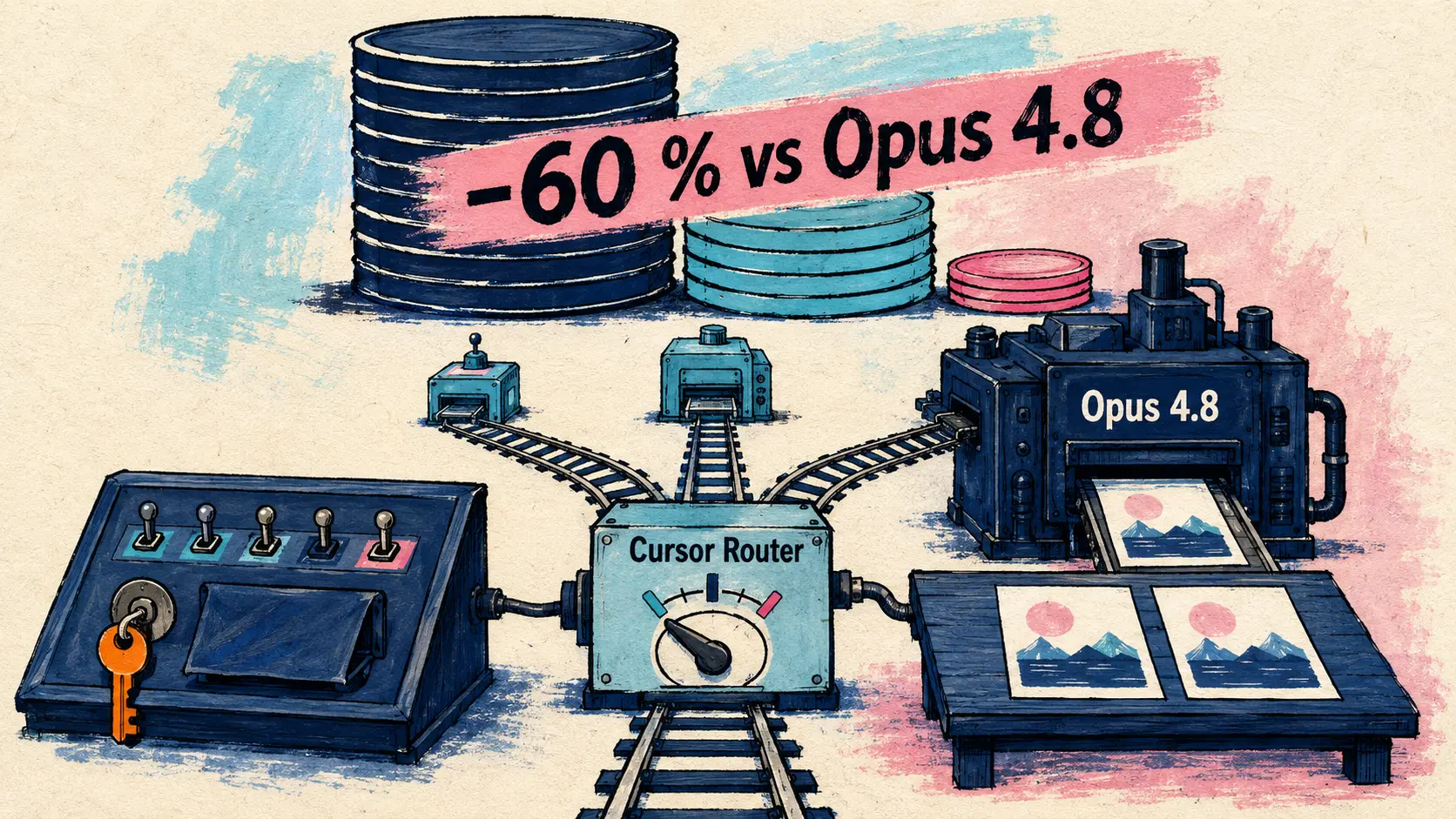
Cursor launches Cursor Router, smart model routing at 60% lower cost
July 22 — Cursor has launched Cursor Router, a model router built into Auto mode that analyzes each request and automatically selects the model best suited to the task, rather than systematically sending every request to a frontier model (frontier). The feature is available starting today across all surfaces (desktop, web, iOS, CLI, SDK) for Teams and Enterprise plans.
| Optimization mode | Goal | Billing |
|---|---|---|
| Intelligence | Systematic frontier quality | Rate of the model actually used |
| Balance | Near-frontier quality, everyday use | Rate of the model actually used |
| Cost | Good quality, token-optimized | Rate of the model actually used |
On the admin side, Teams and Enterprise groups have fine-grained controls: enable or disable Router by team, restrict the available modes, set a default mode, allow or block certain underlying models, and choose whether to display the name of the actually routed model (hidden by default). Soft or strict enforcement options make it possible to standardize the use of Auto mode across an organization.
In early access, customers observed no drop-off in quality with a lower cost per commit vs. routing all requests to Opus 4.8. — @cursor_ai on X
OpenAI Presence, a voice and text agent platform for the enterprise
July 22 — OpenAI launches Presence, an AI agent platform aimed at enterprises to deploy reliable voice and text agents in production, beyond a simple technical demo. Presence combines model reasoning with policies, guardrails, and human escalation rules.
Each deployment starts with a specific task (billing, insurance claims, internal IT requests): the agent receives only the necessary knowledge and system access, and the customer company defines what it can do, when human validation is required, and when a person must take over. After production rollout, real sessions and escalation cases reveal system gaps; Codex then proposes updates that teams test and validate, allowing the agent to adapt as user behavior evolves.
Starting today, Presence supports real-time voice and text experiences for customer support, outbound sales, or high-stakes internal workflows. The product is available to eligible enterprise customers through a limited general availability program, with direct support from OpenAI teams and then, for ongoing follow-up, by selected system integrators.
Project Camellia, OpenAI’s 3.2-gigawatt data center in Georgia
July 22 — OpenAI details Project Camellia, a long-term AI infrastructure project in Effingham County, Georgia. The company has contracted with Georgia Power for 3.2 gigawatts of power, delivered in phases between 2028 and 2032.
On electricity, OpenAI commits to covering all infrastructure and service costs, with no pass-through to residents’ rates, and the site is designed to proactively reduce consumption during peak demand before residential customers are affected. On the water side, a closed-loop system recirculates water rather than drawing and discharging it continuously, for ongoing consumption comparable to that of an equivalent office building.
Economically, OpenAI announces 71 million in Codex credits for eligible students at Georgia colleges, community colleges, and technical schools, each receiving $100 in credits through their ChatGPT account.
Qwen-Image-3.0, Alibaba’s third-generation image generation model
July 22 — Alibaba has launched Qwen-Image-3.0, the third generation of its image generation model, summarized by the team with a single slogan: “Real” (“实”), following the precision of version 1.0 and the variety/completeness of 2.0.
| Dimension | What it concretely changes |
|---|---|
| Rich content | Prompts up to 4.5k tokens; complex layouts in one pass (newspapers, storyboards, exam subjects, 3×3 infographic grids, nested interfaces) |
| Authentic details | Readable text down to 10px, complete LaTeX pages, near-photorealistic textures (pores, hair strands, skin) |
| Deep knowledge | Native rendering in 12 languages, more than 100 artistic styles, realistic interfaces (web, games, streams), live web retrieval |
One highlighted example from Alibaba illustrates this “horizontal expansion”: with only 3.7k tokens, the model generates a 3×3 infographic covering nine very different domains (tunnel safety, spatial geometry, stylistic analysis of a classical Chinese text, projectile motion, parasitology, medical diagnosis, Sylow theorems, banking controls, DNA structure), with accurate text and visuals in each box. Alibaba positions the model not as a simple “nice to look at” tool, but as a productivity tool for design, content creation, education, and e-commerce. It is now accessible via Qwen Chat.
Synthesia launches Roleplay Sessions for professional training
July 22 — Synthesia launches Roleplay Sessions, the first building block of its future “Sessions” platform dedicated to AI-powered professional training. The idea: a live training conversation with an avatar that responds and pushes in real time, coaches the user with a scoring system, and then measures skill progress at the team level. The stated target is sales, management, customer service, and any situation where an employee needs to practice a difficult conversation.
| Metric | Value |
|---|---|
| Core skills disrupted by 2027 (Synthesia source) | 44% of employees |
| Employers saying they lack the capacity to close the gap | 63% |
| Average upskilling (major global recruiting firm) | around 30% |
| Salespeople returning to practice voluntarily (Fortune 10 company) | around 70% |
Roleplay Sessions aims to bring together, on a single platform, four steps usually scattered across different tools — inform, practice, coach, and measure — by relying on the Synthesia video base, already used by 90% of Fortune 100 companies. The first deployments concern a major European group and a Fortune 10 company.
DOE Genesis Mission: Google, OpenAI, and Arcee AI multiply commitments
July 22 — Three separate players announced new commitments on the same day around the Genesis Mission, the U.S. Department of Energy (DOE) initiative aimed at doubling the pace of scientific discovery within a decade.
| Organization | Commitment | Detail |
|---|---|---|
| Google DeepMind | $40 million | AI tokens and Google Cloud credits to give more national lab researchers access to Gemini and other models |
| OpenAI | $17 million | Codex access for about 2,000 researchers, API support for two scientific campaigns, up to 2.5 million spent, access to GPT-Rosalind for biology |
| Arcee AI | Partnership (amount not disclosed) | Building Genesis-Science-1 (GS1), an American open-weight model paired with a governed research harness for scientific computing workflows |
Google is expanding an already established collaboration around computational biology (AlphaFold, Isomorphic Labs). OpenAI is building on prior work with the national laboratory system, including an “AI Jam” session that brought together more than 1,000 scientists from nine labs. Arcee AI, for its part, is opening a contribution program aimed at researchers, labs, universities, companies, and non-profits; the project is still at an early stage, with no release date or benchmark disclosed for GS1 at this point.
🔗 Google DeepMind on X — 🔗 OpenAI on the topic — 🔗 Arcee AI on X
Anthropic multiplies announcements around Claude
Claude Security enters beta for Claude Code
July 22 — Anthropic is launching the Claude Security plugin for Claude Code in beta: scanning ongoing changes for vulnerabilities before committing, or performing a full repository analysis, all from the terminal, relying on the Claude inference already in use (no separate third-party service to provision). This launch positions Claude Code on the same ground as OpenAI’s Codex Security or GitHub Copilot’s strengthened secret scanning. No pricing or affected plans beyond beta status are specified.
Claude can query the Anthropic Economic Index via a connector
July 22 — A new native connector provides access to the Anthropic Economic Index, the public dataset measuring AI usage in the economy. Once enabled from the connectors menu, Claude can answer questions such as “which jobs use AI the most” by drawing directly on the Index’s data rather than its general knowledge.
Claude Managed Agents: effort, seeding, 500 skills, and webhooks
July 22 — Anthropic is rolling out a batch of features for Claude Managed Agents: configurable effort levels per agent (faster and cheaper responses at lower effort), “seeded” sessions with up to 50 events right at creation, up to 500 total skills across all agents in a session, webhooks for environments and memory stores, and streaming of sub-agent events.
Claude Code on desktop integrates with the iOS simulator
July 21 — Claude Code on desktop now supports the iOS simulator: the application can be built and launched by Claude, which observes it, interacts with it, and iterates until the task is complete, in a panel alongside the conversation. Available today in public beta, limited to macOS and requiring Xcode.
🔗 Claude Security — 🔗 Economic Index — 🔗 Managed Agents — 🔗 iOS simulator
Code tools: Amp, Warp, and Replit
Amp launches Multiplayer, real-time collaboration on orbs
July 22 — Three weeks after launching agents in orbs, Amp adds Multiplayer: the same orb can now be shared and worked on simultaneously by several members of a workspace, with messages sent to the agent, portal viewing, live file change monitoring, and a shared terminal, all activatable from the Share menu of a thread.
Warp adds support for OSC 8 hyperlinks
July 22 — Warp ships support for OSC 8, a terminal standard that allows CLIs and coding agents to emit clickable links instead of plain text. Developed by an external contributor on a request opened five years ago, the feature is being rolled out in Dev behind a feature flag, while additional testing is carried out on the terminal grid rendering engine.
Replit relaunches its mobile app
July 22 — Replit releases a redesign of its mobile app (iOS, gradual rollout on Android): revamped home screen, voice input to speak directly to the Agent, swipe navigation between chat, tasks, and preview, and iOS Live Activities that track the agent’s progress live, even outside the app.
🔗 Amp Multiplayer — 🔗 Warp OSC 8 — 🔗 Replit mobile
Microsoft Asia publishes Mage-Flow, a compact image generation model
July 22 — Microsoft Asia publishes Mage-Flow on Hugging Face, an image generation and editing model with only 4 billion parameters that claims quality comparable to much larger models. In terms of performance, the model generates an image in 4 steps in under a second at 1024×1024, and can scale up to 4K. A demo is available via Hugging Face Spaces.
Gemini: Galaxy Unpacked 2026 and Gemini 3.5 Pro
Three Gemini updates on the Samsung side
July 22 — Alongside Galaxy Unpacked 2026, Google details three Gemini updates for the Galaxy ecosystem: expanded task automation across more than 40 popular apps (shopping, reservations, ticket purchases, able to process complex images as instructions and run in the background); Gemini Notebook (the former NotebookLM) preinstalled on the Galaxy Z Fold8 series, with six months of Google AI Pro trial included; and Gemini on the Galaxy Watch 9 (activated with a simple wrist raise, no wake word), with smart glasses developed with Samsung (Gentle Monster and Warby Parker frames) planned for fall 2026.
Gemini 3.5 Pro enters partner testing
July 21 — Josh Woodward, VP in charge of Gemini, confirms that the next flagship model, Gemini 3.5 Pro, has officially entered testing with partners. No general availability date is given, but this confirmation places Gemini 3.5 Pro as the next major expected release on the Gemini model side.
🔗 Galaxy Unpacked 2026 — 🔗 Gemini 3.5 Pro
Manus launches Plan Mode
July 22 — Manus introduces Plan Mode, a structured review step before execution: rather than jumping straight into building, the agent generates a feasibility plan in Markdown, with goals, steps, and constraints, which the user can edit or send back for review before approval. Activation is done via / on the web or + on mobile; the mode can also be triggered mid-task to plan subsequent phases. Available immediately to all users, on web and mobile, opt-in.
GitHub Copilot: Canvases and billing
GitHub Copilot launches Canvases
July 21 — GitHub introduces canvases, interactive workspaces within the GitHub Copilot app where developers and agents collaborate in real time: visualizing complex information, direct interactions (clicks, edits), and refinement through prompt iterations. Creation via the /create-canvas command. Illustrated uses include issue sorting by scanning cards, interactive architecture diagrams, worktree dashboards, prompt-quality coaching, and multi-platform knowledge search. One user documented a case where the app automatically launched a browser canvas to click through to the payment screen and verify a feature, replacing a hand-written Playwright test.
What Copilot brings beyond raw API access
July 22 — GitHub explains its billing policy, now based on AI credits charged at the published API rates of the models. Code completions and Next Edit Suggestions remain included in paid plans; chat and agentic tasks consume AI credits. GitHub’s argument: beyond model access, Copilot brings an integrated flow (issues, repositories, pull requests, organization policies), token consumption reduced at task-resolution parity according to its evaluations, policy controls for administrators, and agent infrastructure already battle-tested in production via the Copilot SDK.
🔗 Canvases — 🔗 Copilot vs raw API access
ElevenLabs: ElevenMusic and Ukrainian public service
ElevenLabs introduces Vocals and Styles on ElevenMusic
July 22 — ElevenLabs adds two features to ElevenMusic, also available in ElevenCreative Finetunes: Vocals, which make it possible to generate original songs with one’s own voice or a voice from the vocal library (uploading tracks to fine-tune Music v2 on its timbre, or one-shot mode from a single recording); and Styles, for stylistic consistency across full tracks, compatible with Vocals. ElevenLabs specifies that all uploads are checked for copyright compliance.
ElevenLabs equips Obrii (Ukraine) with a voice assistant for public employment services
July 22 — Obrii, the new digital ecosystem for the Ukrainian labor market, launches its first AI service: a voice assistant developed with ElevenLabs for the public employment service, accessible 24/7, including during air raid alerts.
“Together with @ElevenLabs, we launched AI voice assistant for the State Employment Service — bringing public services closer to people, 24/7, even during air raid alerts.” — @C_o_S on X
🔗 ElevenMusic Vocals and Styles
NVIDIA: medical simulation, Texas plant, and Cosmos models
Open-source framework for medical physical simulation
July 22 — NVIDIA releases open source, in NVIDIA Isaac for Healthcare, a GPU-accelerated medical physics simulation framework, presented as the first of its kind: interactions between medical devices (catheter, guidewire) and patient anatomy, combining classical physical simulation and generative AI (Cosmos-H Dreams). By running 8,192 environments in parallel, NVIDIA says it reduced a robotic policy training time from more than five hours to less than two minutes. CMR Surgical, Johnson & Johnson MedTech, XCath, and Medtronic Structural Heart already use it; available now on GitHub.
NVIDIA and Wistron open a superchip factory in Fort Worth
July 21 — Wistron opens its first U.S. factory, a 30,000 m² site in Fort Worth, Texas, which already produces Grace Blackwell Ultra superchips and will eventually manufacture Vera Rubin chips. A 500 billion commitment to AI platform manufacturing in the United States.
Cosmos 3 Super, up to 25 times faster
July 22 — NVIDIA releases Cosmos 3 Super, a 4-step variant of its Cosmos 3 family, generating images and videos up to 25 times faster than the original models, while maintaining a high ranking on Artificial Analysis: first place in image-to-video (without audio), second place in text-to-image. Available now on Hugging Face.
Nemotron Model Reasoning Challenge results on Kaggle
July 22 — NVIDIA publishes the results of its Nemotron Model Reasoning Challenge on Kaggle: more than 5,000 participants across more than 4,000 teams, focused on techniques for improving the reasoning of open models. The NullSira, vli, and YS-L teams finish in the top three spots.
🔗 Medical simulation — 🔗 Wistron factory — 🔗 Cosmos 3 Super — 🔗 Kaggle results
Kimi K3: second on AA-Briefcase, but expensive and slow
July 21 — Artificial Analysis publishes the results of Kimi K3 (Moonshot AI) on AA-Briefcase, its agentic knowledge-work benchmark (spreadsheets, presentations, interface mockups). The model earns the second-best recorded score, a jump of more than 700 points over the previous generation.
| Evaluated model | AA-Briefcase Elo | Average cost per task | Average time per task |
|---|---|---|---|
| Claude Fable 5 (max) | 1574 | — | — |
| Kimi K3 | 1543 | $10.57 | 56.4 minutes |
| GPT-5.6 Sol (max) | 1501 | — | — |
| Claude Sonnet 5 (max) | 1388 | — | — |
| Claude Opus 4.8 (max) | 1347 | — | — |
| Kimi K2.6 (baseline) | 816 | ~$1 | — |
Kimi K3 posts a 51% pass rate on evaluation grids, just behind Claude Fable 5 (56%), with comparable analytical quality but weaker presentation quality. The downside: an average cost of $10.57 per task, about ten times higher than Kimi K2.6, a consequence of the model’s pricing, high output token usage, and an average of 83 turns per task (versus 67 for Claude Fable 5 and 50 for GPT-5.6 Sol).
OpenAI: press usage and API caps
How newsrooms use OpenAI tools
July 22 — OpenAI publishes an overview of how news organizations use its tools. The Associated Press uses them for reporting, verification (upload tracing, geolocation, and chronolocation of images and videos), turning thousands of Supreme Court records into structured information, and converting articles into scripts for broadcast, while keeping journalists in control of editorial judgment. POLITICO analyzes large volumes of public documents for faster original reporting; Axios is also cited. OpenAI renews its support for the American Journalism Project and continues its partnerships with the Lenfest Institute and WAN-IFRA.
Strict spending caps extended to all API accounts
July 22 — OpenAI extends, this week, access to strict spend limits (hard spend limits) to all API Platform accounts, allowing each developer to cap usage at an amount of their choice, with real-time usage tracking from the dashboard.
🔗 Press usage — 🔗 API caps
Cohere: Arabic diacritization and lightweight code model
Speech Tashkeel 2B and the Transcribe Arabic community ecosystem
July 22 — Cohere highlights Speech Tashkeel 2B, a partner model developed by NAMAA that converts raw Arabic into fully diacritized text (case markers, harakāt, tanwīn, sukūn, shadda), with a 4-bit quantized version. The announcement is accompanied by community contributions around Transcribe Arabic, Cohere’s Arabic speech recognition model: the listen-habibi app, native Ruby support, and GGUF/ONNX quantizations published on Hugging Face. Cohere also announces a partnership with HUMAIN to extend this work to other low-resource languages.
North Mini Code, a lightweight and economical code model
July 21 — Cohere presents North Mini Code, an open-source code model designed for repetitive, low-complexity tasks — debugging, unit test creation — positioned as an economical alternative to larger models to keep inference costs down.
🔗 Speech Tashkeel 2B — 🔗 North Mini Code
Briefs
- Warp publishes a post on the economic tensions facing hypergrowth AI startups — analysis of a tightening in upcoming revenue for fast-growing startups. 🔗 Source
- Hugging Face hosts its first event in Japan, in Tokyo — presentation of recent tooling and the company’s plans for the Japanese market, in Otemachi. 🔗 Source
- Ai2 releases a new version of PaperFinder — scientific document search tool praised by a regular user researcher, with no technical details disclosed. 🔗 Source
- Sakana AI publishes a general overview of Fugu, “One Model to Command Them All” — blog post broadening the orchestration model’s scope beyond the already covered Fugu-Cyber variant. 🔗 Source
- Gemini Live — camera guide for real-time visual assistance — point the camera at an object or document to get contextual help without having to describe the situation in writing. 🔗 Source
- AlphaFold — new application in protein engineering as the 5-year mark for the foundation approaches — Pushmeet Kohli (Google DeepMind) praises an application for filling structural blind spots in biology. 🔗 Source
- New Copilot metrics impact dashboard (Enterprise) — adoption cohorts (Code-first, Agent-first, Multi-agent, Passive) with velocity and merge metrics per user. 🔗 Source
- Copilot Business/Enterprise — visibility into AI credits by billing cycle — display now possible even without an assigned individual budget. 🔗 Source
- GHES — upcoming hardening of support bundle uploads (August 18, 2026) — upload rejections from unpatched instances; update required to 3.21.3, 3.20.5, 3.19.9, 3.18.12, or 3.17.18. 🔗 Source
- NVIDIA launches Jetson Thor T2000 and T3000 modules — new modules for robotics and edge AI, with no detailed spec sheet available yet. 🔗 Source
- Cisco launches Antares, small models for code vulnerability detection — Antares-350M and Antares-1B, available on Hugging Face, runnable locally to avoid sending sensitive code to the cloud. 🔗 Source
- HeyGen HyperFrames — Day 17/30: the Storyboard flow — three-pass plan (cards, sketches, final render) with frame-by-frame comment-based review. 🔗 Source
- Kling AI publishes an MCP tutorial for creating cinematic performances with agents — complete creative flow in an agent: character, emotion, batch video generation. 🔗 Source
- A family builds a treehouse with ChatGPT as consultant — structural design, material choices, and turning the children’s ideas into workable plans. 🔗 Source
- Codex Live Build — live build session — stream with the creators of the Codex Micro keyboards. 🔗 Source
- A player recreates the Italian Dolomites in a video game with Codex — open world “Valdiluce” with climbing, gliding, and a working cable car. 🔗 Source
- ChatGPT Work promotion — $100 in free credits — for the first 10,000 participants posting on X what they like about ChatGPT Work. 🔗 Source
What it means
Model routing is becoming the new battleground for coding tools: Cursor Router promises 60% savings without a perceptible loss in quality by automatically choosing the right model per request, while Artificial Analysis shows, conversely, that Kimi K3, the second-best score on its agentic knowledge-work benchmark, costs about ten times more than its previous generation and takes nearly an hour per task. The message is the same on both sides: raw model power is no longer enough to justify its use; the cost/quality/latency tradeoff is becoming the real decision variable for teams deploying these tools at scale.
Enterprise agents are clearly moving from demo logic to production logic. OpenAI Presence explicitly structures policies, guardrails, and human escalation around model reasoning; Synthesia Roleplay Sessions quantifies concrete gains in skill building under real conditions; GitHub Copilot Canvases documents a case where an agent verified its own work all the way to the payment screen, replacing handwritten tests; and Claude Managed Agents adds effort levels and webhooks designed for complex agentic workflows in production. These announcements converge on the same requirement: making agents reliable and steerable over time, not just capable in a demo.
On the institutional front, the DOE’s Genesis Mission illustrates a race that is now open to three — Google, OpenAI, and Arcee AI — to establish a foothold in U.S. public scientific research, each with its own logic: tokens and cloud credits for Google, Codex access and API for OpenAI, and a governed open model for Arcee AI. This institutional dynamic is paired with a race for physical infrastructure, with Project Camellia (3.2 gigawatts in Georgia) and Wistron’s superchip factory in Fort Worth ($700 million, several hundred jobs) showing that compute capacity and territorial anchoring are becoming communication arguments in their own right, publicly quantified and detailed.
Finally, multimodal generation continues to diversify from the bottom up as well as the top down: Qwen-Image-3.0 pushes realism and the professional utility of a frontier model, while Mage-Flow (Microsoft Asia, 4 billion parameters) and Cosmos 3 Super (NVIDIA, up to 25 times faster) bet on compactness and speed to make these capabilities accessible at lower compute cost. The ElevenLabs/Obrii use case in Ukraine also serves as a reminder that these voice technologies are finding high-impact public-service uses as well, beyond purely commercial use cases.
Sources
- Cursor Router — changelog
- OpenAI Presence
- Project Camellia
- Qwen-Image-3.0
- Synthesia Roleplay Sessions
- Google DeepMind — Genesis Mission
- OpenAI — Genesis Mission
- Arcee AI — Genesis-Science-1
- Claude Security
- Anthropic Economic Index — connector
- Claude Managed Agents
- Claude Code — iOS simulator
- Amp Multiplayer
- Warp — OSC 8 links
- Replit — mobile app
- Microsoft Asia — Mage-Flow
- Galaxy Unpacked 2026 — Gemini
- Gemini 3.5 Pro — partner tests
- Manus Plan Mode
- GitHub Copilot — Canvases
- GitHub Copilot vs raw API access
- ElevenLabs — Vocals and Styles
- ElevenLabs — Obrii Ukraine
- NVIDIA — medical physics simulation
- NVIDIA/Wistron — Fort Worth plant
- NVIDIA — Cosmos 3 Super
- NVIDIA — Nemotron Reasoning Challenge recap
- Kimi K3 — AA-Briefcase
- OpenAI — press usage
- OpenAI — API spending caps
- Cohere — Speech Tashkeel 2B
- Cohere — North Mini Code