ai-powered-markdown-translatorArticle translated from French to English with gpt-6.1-sol.
Levent Alpöge, a mathematician at Anthropic, has published a proof of the Riemann hypothesis obtained with Claude, in the form of a Lean library containing 17 million lines, and the Lean and Mathlib communities certified it the very next day. alphaXiv has published the OpenResearch Intelligence Index, where Claude Opus 5.5 leads autonomous research with 61,8 % while DeepSeek V4.1 Flash, the leading open model at 27,4 %, costs 0,72 dollars per attempt; Meta has raised its Digital Brain Project target to 25 000 hours, and Inkling 2 Mini has joined Transformers and runs at 210 tokens per second on a Mac Studio. Replit, Devin and v0 are strengthening access, network and spending controls, and Claude Code 2.1.330 keeps its scheduled tasks running for up to 30 days.
Mathematics: Levent Alpöge’s proof of the Riemann hypothesis obtained with Claude is certified by the Lean and Mathlib communities
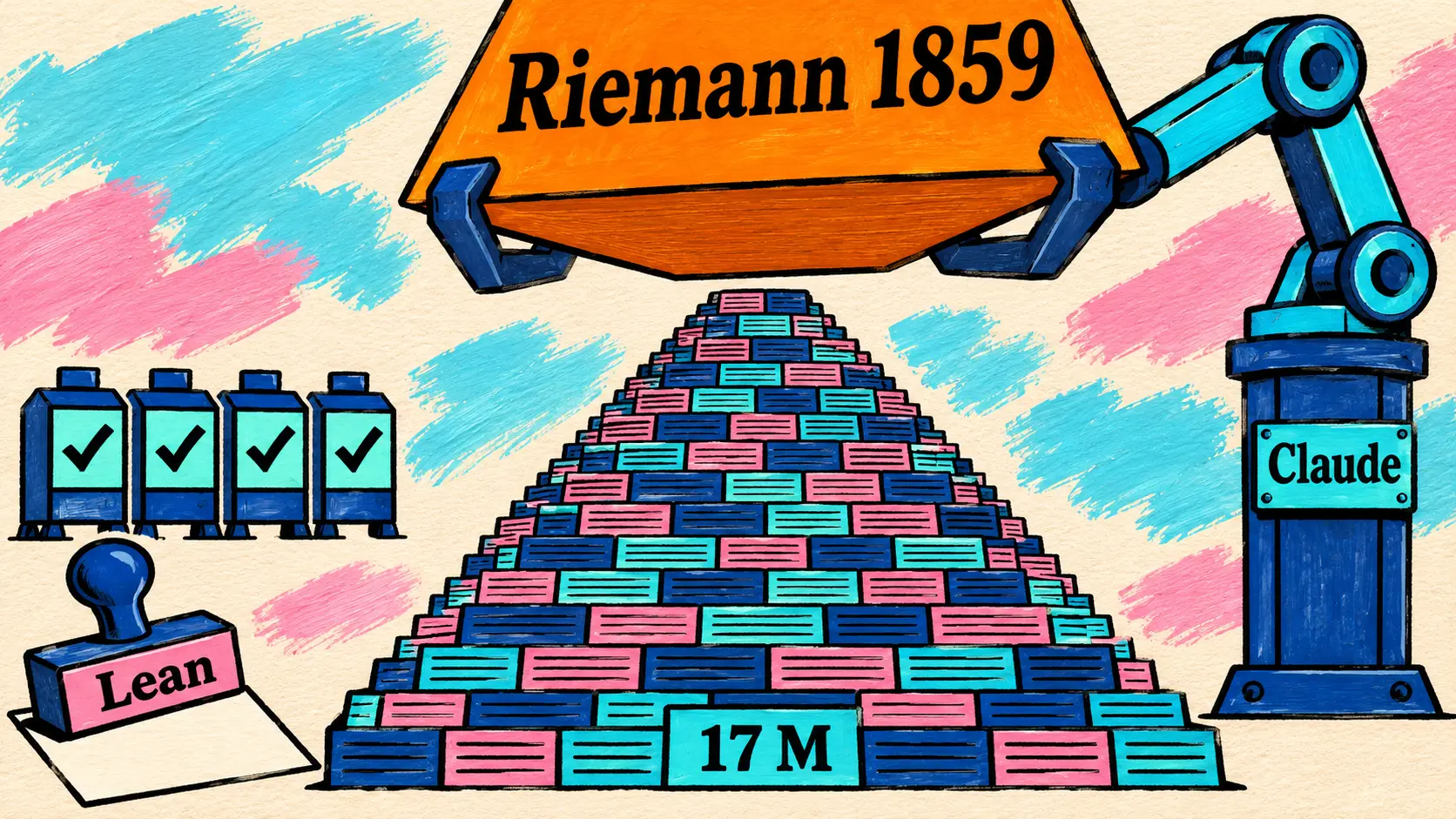
November 20 and 21 — Levent Alpöge, a mathematician at Anthropic, published a proof of the Riemann hypothesis on November 20 in the form of a Lean library containing 17 million lines of code, whose only direct dependency is Mathlib, Lean’s library of formalized mathematics. Proposed in 1859 by Bernhard Riemann, the hypothesis concerns the distribution of prime numbers. He accompanies it with a note, listed on alphaXiv under the title “A Claimed Proof of the Riemann Hypothesis” (A Claimed Proof of the Riemann Hypothesis). According to alphaXiv’s summary, the author claims to have found this proof with Claude, also claims the generalized Riemann hypothesis, and draws on Fourier analysis, theta lifts (theta lifts) and an analogy with Stepanov’s argument over function fields; according to the same summary, the proof is long, and the author intends to explain and simplify it.
On November 21, the Lean and Mathlib communities published a joint statement, supported by the Lean FRO and the Mathlib Initiative, certifying the statement and the proof. Within a day, the library had met the four criteria set out on November 12 by Kevin Buzzard (Imperial College London):
| Verification criterion | Checks carried out by the Lean and Mathlib communities |
|---|---|
| The statement is correct | Mathlib’s RiemannHypothesis statement, reviewed by experts in Lean and number theory |
| The library compiles | dozens of people reproduced the same raw proof export file |
| The theorem proved is this statement | comparison using two independent tools, comparator and con-leche, starting from a file that imports only Mathlib |
| The proof is accepted | Lean’s official kernel, con-leche, con-ron and several checkers written in other languages, using an inert proof export |
We hereby certify that both the statement and the proof of the Riemann Hypothesis are correct. — Lean and Mathlib communities, statement on the Lean community blog
Scientific American reports confirmation from independent mathematicians: Andrew Sutherland (MIT) compiled the result himself and says that Lean’s kernel rechecked it using only the three standard axioms. The Lean and Mathlib statement mentions neither Claude nor the generalized Riemann hypothesis claimed by the author: Claude’s role is reported in Alpöge’s note and Scientific American.
🔗 Levent Alpöge’s note on alphaXiv · Scientific American: confirmation from independent mathematicians · Technical summary of the verification (MIT)
VIDRAFT publishes a live gauge of Weil positivity, showing the statement holding without proving it
November 21 — The day after the proof was published, the VIDRAFT laboratory released a Space on Hugging Face that computes the smallest eigenvalue of the Weil quadratic form, whose positivity is equivalent, according to Weil’s criterion, to the Riemann hypothesis. It is positive for the zeta function and four Dirichlet L-functions (conductors 3, 4, 5 and 8), negative for three imitations that differ from a genuine L-function by a single ingredient, and ten statements in the tool are verified by the Lean 4 kernel. The post reiterates that the formal proof establishes the result, while the instrument merely shows it holding; the code, Lean files and repository are published, and the experiment can be reproduced in around thirty seconds on a free CPU.
🔗 VIDRAFT’s post on Hugging Face · Weil gauge Space
Evaluation: alphaXiv measures autonomous research with the OpenResearch Intelligence Index, an AI text detector climbs RAID’s rankings but loses ground outside the benchmark
November 20 — alphaXiv has published the first results of the OpenResearch Intelligence Index, a benchmark measuring models’ ability to conduct research from start to finish. Each model works in its own harness (Claude Code, Codex or OpenCode), within OpenResearch, alphaXiv’s research environment, across three tracks: scientific knowledge (20 tasks drawn from Terminal-Bench-Science), conducting post-training (6 new tasks) and the relevance of literature selections (a subset of PaperFindingBench).
We created the world’s first open source benchmark for end-to-end autoresearch. Today, its results are live. Which models are best for RSI? Can they understand the literature? Can they conduct complex scientific experiments, while maintaining good taste? We spent about $7.4k in tokens across 8 models, 6 providers, and 3 evaluation tracks to find out. — @askalphaxiv on X
| Model evaluated | Harness used | Index score | Average cost per attempt |
|---|---|---|---|
| Claude Opus 5.5 | Claude Code | 0,618 ± 0,014 | 16,46 dollars |
| GPT-6 Astra | Codex | 0,566 ± 0,014 | 22,44 dollars |
| GPT-6.1 Sol | Codex | 0,549 ± 0,024 | 3,83 dollars |
| Gemini 4 Argon | OpenCode | 0,526 ± 0,013 | 9,18 dollars |
| Claude Fable 5.1 (74 attempts completed out of 87) | Claude Code | 0,511 ± 0,015 | 20,07 dollars |
| DeepSeek V4.1 Flash | OpenCode | 0,274 ± 0,018 | 0,72 dollars |
| Kimi K3 | OpenCode | 0,271 ± 0,010 | 10,89 dollars |
| Qwen3.8-Flash | OpenCode | 0,214 ± 0,015 | 4,54 dollars |
Claude Opus 5.5 leads with 0,618, or 61,8 %, at an average of 16,46 dollars per attempt. GPT-6 Astra follows at 0,566, but costs 22,44 dollars, while GPT-6.1 Sol achieves 0,549 for 3,83 dollars; Claude Fable 5.1 completed only 74 attempts out of 87. Open models remain far behind: DeepSeek V4.1 Flash, the leading model among them, achieves 27,4 % for 0,72 dollars per attempt, just ahead of Kimi K3 (0,271) and Qwen3.8-Flash (0,214). On the literature track alone, equipped with OpenResearch’s search tools, DeepSeek V4.1 Flash reaches 47,7 %, compared with 48,7 % for GPT-6 Astra. Together AI, which served the open models, shared the index; alphaXiv has announced more models and the source code.
🔗 alphaXiv’s post on the OpenResearch Intelligence Index · @togethercompute on X: open models put to the test
An AI text detector rises from 27th to 5th place on RAID, but performs much worse outside the benchmark
November 21 — On the Hugging Face community blog, the empirischtech team describes how its AI-generated text detector, built on the 1B Ettin encoder, moved from 27th place out of 58 in the RAID rankings, the position held by its production detector, to 5th with a version tuned for RAID: at 1 % false positives, the detection rate rises from 92,81 % to 99,20 %. The downside appears outside the benchmark: on the authors’ test set, the share of AI texts detected falls from 97,8 % with the general-purpose detector used as the starting point for fine-tuning to 58,7 % with the version tuned for RAID, while the share of human texts incorrectly flagged rises from 1,0 % to 2,4 %. The version tuned for RAID therefore remains a research tool; the authors’ service uses a separate general-purpose detector.
🔗 empirischtech’s post on Hugging Face
AI for science: Meta raises its Digital Brain Project target to 25 000 hours and presents UMA Nitro and ATLAS, Diffusers fine-tunes RFD4-Proteina
November 20 — Meta has published a recap of its Open Source AI for Science Summit, organized over two days in October by its FAIR laboratory in Menlo Park. The main numerical announcement: the Digital Brain Project, launched with the Rothschild Hospital Foundation and Université de Montréal to fund the collection of anonymized, openly shared brain data, has raised its target from 15 000 to 25 000 hours of data.
| Project presented at the summit | Scientific field | What Meta’s post says |
|---|---|---|
| Digital Brain Project | Neuroscience | target raised from 15 000 to 25 000 hours of brain data |
| UMA Nitro | Chemistry | faster version of the UMA atom model (Universal Model for Atoms), with no speed figure |
| UMA Playground | Education | offered to secondary school chemistry teachers through Discovery Education, which reaches over 4 million teachers and 45 million students |
| ATLAS (FAIR) | Mathematics | open library that formalizes 26 freely accessible textbooks and over 45 000 definitions and results in Lean |
UMA also identifies numerous crystal forms of drug molecules without additional training data (a study with Carnegie Mellon and UC Riverside), and simulates entire enzymes, atom by atom, with the University of Chicago. The post also discusses an assistive robotics system from the University of Pittsburgh, built on DINOv3 and SAM 3, with a demonstration set to show a robot helping a person eat.
🔗 Open Source AI for Science Summit recap (Meta) · @AIatMeta on X
Diffusers adds a LoRA fine-tuning example for RFD4-Proteina, NVIDIA’s protein design model
November 20 — Hugging Face’s Diffusers library has added a LoRA fine-tuning example for RFD4-Proteina, NVIDIA’s open protein design model (covered here on October 21). Announced by Sayak Paul, the example (pull request #15155 by kierandidi, merged on November 19) trains rank 32 adapters on the denoiser, with flow matching losses applied to protein backbone coordinates and local latents rather than pixels; according to him, the rest of the code resembles that used for image and video models.
Open models: Inkling 2 Mini joins Transformers v5.24.0, runs at 210 tokens per second on Mac and gets an uncensored version
Inkling 2 Mini, Thinking Machines’ open-weight looped model released on November 20 (covered here yesterday), was integrated into Hugging Face’s reference library, ported to Mac and uncensored within twenty-four hours of its release.
Transformers v5.24.0 adds Inkling 2 Mini, Meta’s Omnilingual ASR, NVIDIA’s Dory and Sarvam-105B
November 21 — Hugging Face has released Transformers v5.24.0, adding around ten architectures. Inkling 2 Mini joins with a research checkpoint featuring a variable loop count, and Dory, NVIDIA’s looped model, also allows the number of loops to be adjusted at inference time.
| Model added | Model publisher | Release details |
|---|---|---|
| Inkling 2 Mini | Thinking Machines | with the TML-d24-varloop-research research checkpoint, featuring a variable loop count |
| Dory | NVIDIA | looped model, number of loops adjustable at inference time |
| Omnilingual ASR | Meta FAIR | speech recognition for over 1 600 languages, from 300M to 7B, CTC head or Llama decoder |
| Apertus 1.5 and WavTokenizer | Swiss AI Initiative | text, image and audio inputs; audio codec at 24 kHz |
| HY4-VL | Tencent | vision-language model from the Hunyuan V4 family |
| Lara Mini | Translated | 7,2B with 0,6B active, CC BY-NC-SA 4.0 license |
| Sarvam-105B and Sarvam-30B | Sarvam AI | 105B: MLA attention, 128 experts with 8 active, 131K context |
| EXAONE 3.0, 3.5 and Deep | LG AI Research | loaded without trust_remote_code |
Take care when updating: past_key_values and cache_params are renamed cache, a change classified as breaking even though the old names are still accepted with a deprecation warning, and the minimum PEFT version has been raised accordingly. Ling 3.1 Flash now loads natively, and LayoutLMv3 uses the SDPA attention interface.
EXO Labs runs Inkling 2 Mini at 210 tokens per second on a Mac Studio M5 Ultra
November 21 — The day after Inkling 2 Mini’s release, EXO Labs publishes throughput figures obtained in collaboration with Thinking Machines on two Macs.
| Machine tested by EXO Labs | Generation (decoding) | Prompt processing (prefilling) |
|---|---|---|
| Mac Studio M5 Ultra, 96 Go | 210 tokens/s | 3 620 tokens/s |
| MacBook Pro M5 Max, 48 Go | 125 tokens/s | 1 750 tokens/s |
According to EXO Labs, the model built a native weather app 1.8 times faster than Claude Sonnet 5.5 on the Mac Studio, at one-eleventh the cost based on API pricing. EXO Labs explains that the looping architecture suits machines with limited memory, such as MacBooks: looping through layers increases inference compute without making the model larger. Julien Chaumond of Hugging Face sees this as how local, open source AI will win.
We got access on Wednesday. In 3 hours we had it running at 30 tok/sec A day later we had it running 210 tok/sec (7x faster) — @exolabs on X
🔗 @exolabs on X: Mac throughput figures · @julien_c on X
OpenUncensored publishes an unrestricted version of Inkling 2 Mini on its release day
November 20 — On the very day Inkling 2 Mini launches, OpenUncensored, an API provider for uncensored models, publishes an “abliterated” version, stripped of its ability to refuse through a targeted modification of its weights. Across 32 harmful requests, it goes from 32 refusals to none, in both conversation and reasoning, with no drop in its MMLU score (79.47% versus 78.95% for the original). Only 20 BF16 attention tensors were modified: because the middle layers are used three times per token, a modification there takes effect three times. The API costs $0.15 per million input tokens and $0.60 per million output tokens; the author urges caution with samples this small.
🔗 OpenUncensored’s post on Hugging Face
Enterprise coding platforms: private networking with Replit Tunnels, access and sharing in Devin, spending caps in v0
Replit Tunnels connects Replit environments to services on a private network, in early access
November 20 — Replit introduces Tunnels, which connects its environments to services on a company’s private network (databases, internal APIs) without opening that network to public inbound connections. Traffic passes through a client that the IT department runs inside the network, deployed using a generated Docker command or a Helm chart on Kubernetes, and IT chooses which services each Replit workspace can reach. The connection between this client and Replit is encrypted and authenticated using mTLS; authentication and TLS for each private service are configured separately.
Tunnels integrates with connectors: connector authentication requests, Agent tool calls and requests from published apps pass through Replit’s tunnel server and then through this client. The post cites three use cases: identifying customer accounts to review in finance (Stripe, SharePoint, Snowflake), finding pending patient referrals in healthcare (Calendly, DrChrono) and flagging equipment stockouts in industry (NetSuite, Shopify, Databricks, Shippo). Tunnels is in early access, available on request, with no pricing specified; it extends Bring Your Own Cloud (covered here on October 17), which already relied on outbound tunnels with double mTLS.
🔗 Replit’s post on Tunnels · Documentation: Set up Tunnels
Devin introduces Access and Sharing, user groups and per-session sharing, and adds to its November 17, 18 and 19 release notes
November 20 — Devin’s November 20 release notes introduce Access and Sharing, enterprise access and sharing controls that are rolling out gradually and are disabled by default: customers must contact their Cognition representative to enable them. A User groups page in Settings lets users create groups that can be used wherever access is managed: secrets, environments, sessions, automations, plugins, playbooks, skills, MCP servers and knowledge.
Each session gets its own sharing settings: only you, one or more groups, the organization or the entire account. A session that uses a repository, secret or environment restricted to you or your group starts privately, with a warning before broadening its visibility. In Slack, it still replies in the channel, but only people it is shared with can give it instructions. Administrators receive a report of repositories whose access in Devin differs from GitHub or GitLab, and Devin Review, DeepWiki and Ask are limited to repositories the user can access. Separately from this rollout, the same notes add a Triaged status to security findings and the Sazabi plugin to the marketplace; no pricing is mentioned. 🔗 November 20 notes
The release notes from the previous three days also add:
- November 19 — In Devin Review, per-repository billing rules charge a repository’s reviews, including chat, to an organization or budget rather than the PR author. On the security side, a Validate with Devin button has a finding validated, and, for two or more findings, Fix with Devin offers one PR per root cause, one per finding or a single PR for all of them; the marketplace removes MCP servers replaced by native integrations (Slack, Linear, GitLab, Pylon). 🔗 November 19 notes
- November 18 — A Shared with selector appears in the home composer, and the Start sessions as Only you setting keeps sessions private by default. A private session does not post to Slack, making it visible requires confirmation that names the people concerned, and organization attachments follow its visibility; Devin Review gains an Update branch button, and the DevinDash MCP leaves beta. 🔗 November 18 notes
- November 17 — Devin Review posts a status on Azure DevOps pull requests, PR security review findings can include a short impact summary, and Devin posts images, rich text, tables, charts, cards and carousels in Slack. 🔗 November 17 notes
v0 makes per-member spending caps available to all enterprise customers
November 20 — v0 makes its spending caps (Spend Caps) available to all enterprise customers. In Settings → Members, team owners set a default limit for members or an individual limit for each person, governing use of the shared credit pool per billing cycle once the member’s included credits run out. When the limit is reached, generation stops at the end of the current step and the member can request additional access; no amounts are specified.
Coding agents: Claude Code 2.1.330, Antigravity 2.34.0, Copilot CLI, Qwen Code, Codex CLI and Amp’s Puck in the car
Claude Code 2.1.330 draws charts with easel and lets scheduled tasks run for up to 30 days
November 20 — Claude Code 2.1.330 has 142 entries, including 98 fixes, 16 additions, 14 improvements and 13 changes. It adds easel, a built-in mod that draws charts on request and beneath metric results returned by an MCP server, such as a Prometheus range query. easel is available on Pro, Max and, where available, Team and Enterprise, on macOS and Linux; its automatic charts can be disabled in /config. Organizations managed in Anthropic’s Enterprise Admin Console (Enterprise Admin Console) can also connect through it: after claude auth login, Claude Code applies their settings and routes through their cloud provider or gateway.
Recurring scheduled tasks and /loop now run for up to 30 days instead of 7, as long as their session stays open; those created before this version still stop after 7 days. More rm commands targeting the root, home directory, a top-level directory or the working directory require approval, and are denied when no one can respond. Automatic retry on max_tokens, removed in 2.1.329, is restored, and ExitWorktree no longer deletes a worktree another session is working in. On Google Cloud’s Agent Platform, claude -p finally honors fast mode passed through --settings when the model comes from ANTHROPIC_MODEL or a settings file: these runs are now billed at fast mode rates. The VS Code extension receives 28 entries, including /fork and /workflows.
Other coding agents: Antigravity 2.34.0, Copilot CLI and Copilot SDK previews, Qwen Code v0.28.3, Codex CLI 0.173.0-alpha.4 and Amp’s car mode
- Antigravity 2.34.0 (November 20) — Google’s app has 15 improvements and 24 fixes. Its title announces MCP Apps support, which the improvements list does not detail; Gemini 4 Neon and the Orchestrator (Neon) option become available to eligible paid consumer plans, Neon becomes usable with a Gemini API key or Google Cloud’s default credentials (Application Default Credentials), and Enterprise accounts receive Orchestrator. The Marketplace gains the Clerk, Docusign and TestMu AI plugins. 🔗 Antigravity changelog
- Copilot CLI 1.0.115-4 through 1.0.115-6 and Copilot SDK 2.0.2-preview.2 through preview.5 (November 20 and 21) — In these CLI previews, ACP editors that support forms display structured clarification questions (structured clarification questions), and long local sessions take up less disk space; the stable release remains 1.0.114. The SDK adds Gemini 4 Neon to its model list (1 048 576-token context, 65 536 output tokens), reads
.claude/CLAUDE.mdat the repository root, then gains topic-based cloud memory and APIs for importing sessions and memory, both experimental. 🔗 Copilot CLI 1.0.115-4 · Copilot SDK 2.0.2-preview.2 - Qwen Code v0.28.3 (November 21) — This new stable release directly follows v0.28.0 and incorporates the November 20 preview, covered here yesterday: GitHub becomes the third supported channel, WeCom and Microsoft Teams arrive, a generic outbound-only webhook pushes results to an HTTPS endpoint, and ACP and OpenTUI sessions run on the shared agent loop; the notes report no breaking changes. 🔗 Qwen Code v0.28.3
- Codex CLI 0.173.0-alpha.3 and alpha.4 (November 20 and 21) — The notes are empty; according to the 15 PRs merged since alpha.2, each command or MCP tool hook accepts an
onFailureoption:continueby default, orblock, with which a failedPreToolUseprevents the tool from running and a failedPostToolUsewithholds its result. Cloud-managed configuration also loads throughcodex plugin addandcodex plugin list; the stable release remains 0.171.0, and this content may still change. 🔗 Codex CLI 0.173.0-alpha.4 - Puck in the car at Amp (November 21) — Amp lets users talk to Puck, its meta-agent, while driving, without looking at a screen: the iPhone app (with CarPlay) and Android app (with Android Auto or the car’s Bluetooth) switch to car mode, and on an in-car browser, such as a Tesla’s, users simply open ampcode.com/car and scan a QR code with a phone signed into Amp. Anything that needs to be read appears in very large text; no pricing is mentioned. 🔗 Puck in the Car
Briefs
Models and APIs
- Qwen4 Max on Together AI — Following up on the 30% discount covered here on November 19, Together AI lists its prices through November 22: $1.05 per million input tokens and $3.15 per million output tokens, with reasoning billed as output and streaming required. In a single example provided as evidence, the model read all 344 files in the Tornado repository (652 519 tokens) in one request and returned a fix in 72 seconds for 69 cents, validated by the maintainers’ tests. 🔗 source
- Ultrafast in Codex — On OpenAI’s developer blog, Dominik Kundel shares his tips for Ultrafast with GPT-6.2 Astra and Sol (hot reloading, short instructions, Light or Low reasoning) and clarifies two points: token generation up to 4.5 times faster in Codex, and promotional API pricing at 3 times the Standard rate through February 28, 2027, then 6 times starting March 1. 🔗 source
- Hugging Face home feed — Signed-in users now see a feed by default where each trending model release gets its own card, such as one grouping 17 new Tencent models, Victor Mustar announces. 🔗 source
Open research on Hugging Face
- Act-or-Ask — This small open model, fine-tuned with LoRA from Phi-4-mini (3.8B), decides whether a household assistant should act, first ask an adult for permission or refuse. Across 60 unseen situations, it follows household policy in 99.3% of cases, versus 49.7% for the base model with the same rules in the prompt; the model is licensed under MIT and the benchmark under CC BY 4.0. 🔗 source
- KITScenes in FiftyOne — Harpreet Sahota continues his series of FiftyOne conversions with a subset of KITScenes Multimodal, an autonomous driving dataset from KIT and FZI recorded in Frankfurt with 9 cameras, 7 lidars and 3 radars: 680 time steps from 4 scenes, each with its nine camera views and a fused lidar-radar point cloud. 🔗 source
Assistants and business agents
- Google’s Connected Apps — In the United States, Albertsons, Safeway, Shaw’s and Target are coming to Search and the Gemini app to let users assemble and pay for a grocery order through the Universal Commerce Protocol (UCP); Experian, already available in Gemini, and H&R Block are coming to Search, with Angi and Thumbtack to follow in the coming weeks. 🔗 source
- Grok Bot and QuickBooks — SpaceXSI’s agent connects to Intuit QuickBooks in the United States: users can ask about their cash flow, profit or unpaid invoices, and it drafts invoices, estimates and payment reminders, subject to user approval. 🔗 source
- ElevenAgents for Fundación Televisa — In an ElevenLabs case study, a voice agent conducted 1 036 interviews averaging five minutes between June 29 and July 24 with applicants to POSiBLE, the Mexican foundation’s entrepreneur accelerator, which selected 70 projects for its final stage; Bécalos, another foundation program, interviewed 394 young people in two days. 🔗 source
Generative images
- Kling Image 4.0 — Kling shares Artificial Analysis’s evaluation: 7th in text-to-image and 6th in editing, behind only models from OpenAI and Microsoft AI, compared with Kling Image 3.0 Omni’s 86th and 67th places. A limited-time Black Friday offer lists 2K images from $0.022 each and native 8K from $0.033, without specifying whether this applies to the app or the API. 🔗 source
Beyond AI
- GitHub security advisory permissions — Four permissions in the Security category (viewing advisories, creating and managing them, accepting private reports, publishing and requesting CVEs) can now be assigned through custom repository roles, without making the people concerned repository administrators. 🔗 source
What this means
The proof of the Riemann hypothesis shifts trust toward formal verification. A proof spanning 17 million lines cannot be reviewed by hand: its credibility here comes from a public chain of checks, completed in a single day, from the Mathlib statement reviewed by experts to several independent verifiers. The certification says nothing about how the proof was found, or about the generalized Riemann hypothesis, and the author still needs to explain it; but it allows a result obtained with a model to be accepted without having to trust the model. ATLAS, Meta’s library formalizing 26 textbooks in Lean, moves in the same direction.
The OpenResearch Intelligence Index measures something beyond knowledge: the ability to conduct an entire research project, from literature review to post-training. Closed models clearly dominate, but the cost gap matters as much as the score gap: GPT-6.1 Sol scores 0.549 at $3.83 per attempt, while GPT-6 Astra costs $22.44 for a score of 0.566, and DeepSeek V4.1 Flash, at $0.72 per attempt on the index, approaches GPT-6 Astra on the literature review track when equipped with OpenResearch’s tools. empirischtech’s detector highlights the limits of the exercise: after rising from 27th to 5th place on RAID, it detects only 58.7% of AI texts in its own test set, compared with 97.8% for the general-purpose detector it was fine-tuned from. A ranking measures what its benchmark contains, nothing more.
Inkling 2 Mini shows how quickly an open-weight model now spreads: within twenty-four hours, it joins Transformers, runs at 210 tokens per second on a Mac Studio, and loses its refusals in an uncensored version that modified only 20 tensors. The same openness that allows a model to be ported to a workstation in a day also allows its refusals to be removed that very day. Open science, meanwhile, advances through its data and tools: Meta is raising its collection target for shared brain data to 25,000 hours, and Diffusers shows that a fine-tuning recipe designed for images also applies to protein design.
For coding platforms, the day’s focus is governance more than generation. Replit Tunnels selects which private services a workspace can reach, Devin determines who can view and control each session, v0 caps each member’s spending, and Claude Code applies organization settings managed in Anthropic’s Enterprise console. Agents are gaining autonomy, with scheduled tasks running for up to 30 days in Claude Code, but safeguards are keeping pace: approval is required for the riskiest rm, and hooks can block an action on failure in Codex CLI prereleases.
Sources
- Statement from the Lean and Mathlib communities on the proof of the Riemann hypothesis
- Levent Alpöge’s note on alphaXiv
- Scientific American: confirmation by independent mathematicians
- Technical overview of the verification (MIT)
- Weil positivity gauge (VIDRAFT)
- Weil gauge Space (Hugging Face)
- @askalphaxiv on X: the OpenResearch Intelligence Index
- alphaXiv’s post on the OpenResearch Intelligence Index
- @togethercompute on X: open models put to the test
- empirischtech’s post on RAID (Hugging Face)
- Open Source AI for Science summit recap (Meta)
- @AIatMeta on X: the science summit
- @RisingSayak on X: RFD4-Proteina in Diffusers
- Transformers v5.24.0
- @exolabs on X: Inkling 2 Mini on Mac
- @exolabs on X: from 30 to 210 tokens per second
- @julien_c on X: local and open source AI
- Uncensored Inkling 2 Mini (OpenUncensored)
- Tunnels (Replit)
- Set up Tunnels (Replit documentation)
- Devin release notes for November 20
- Devin release notes for November 19
- Devin release notes for November 18
- Devin release notes for November 17
- v0 changelog: Spend Caps
- Claude Code v2.1.330
- Antigravity changelog
- Copilot CLI 1.0.115-4
- Copilot SDK 2.0.2-preview.2
- Qwen Code v0.28.3
- Codex CLI 0.173.0-alpha.4
- Puck in the Car (Amp)
- Qwen4 Max on Together AI
- How I stay in the flow with Ultrafast (OpenAI)
- @victormustar on X: the Hugging Face home feed
- Act-or-Ask (Hugging Face)
- KITScenes Multimodal in FiftyOne (Hugging Face)
- Connected Apps for grocery shopping (Google)
- @bot on X: Grok Bot and QuickBooks
- Fundación Televisa and ElevenAgents (ElevenLabs)
- @Kling_ai on X: Kling Image 4.0
- Security advisory permissions (GitHub changelog)